Engine · 993-ENG-UPPER-VALVE-COVER-ALSI10MG-F0-0001
Upper valve cover with COP towers, F0 AlSi10Mg concept
ConceptNot authorised until engineering review
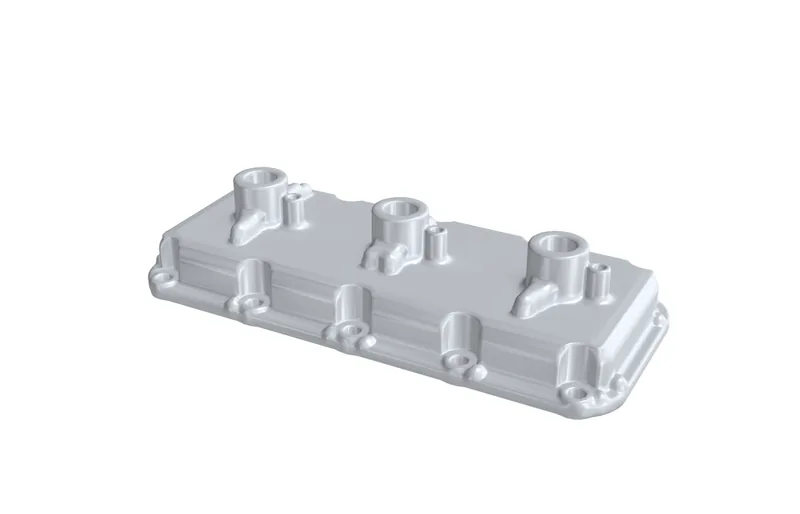
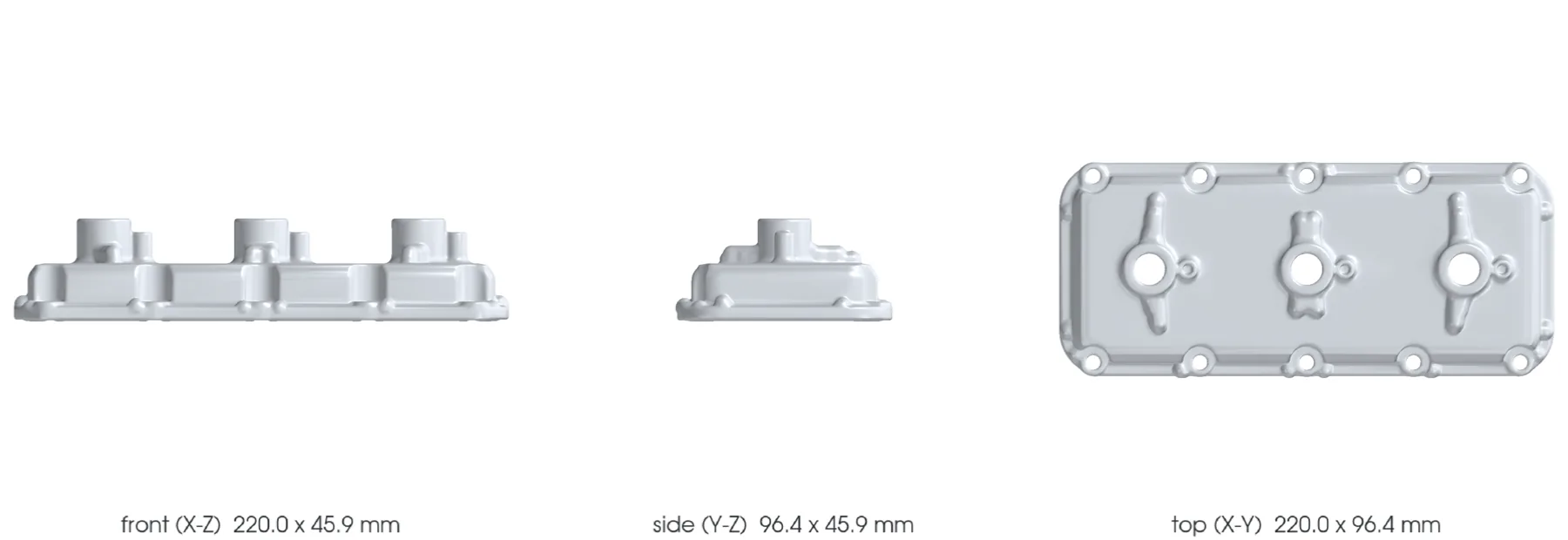
Independent concept of a 993 upper valve cover, open on the oil side, with six fins and three integrated coil-on-plug towers. The sources confirm billet alternatives and interest in COP, but no individual geometry; all F0 interfaces are synthetic.
The design
- Vehicle
- Porsche 993, 1994–1998
- Variants
- 993 Carrera, 993 Turbo
- Porsche part numbers
- Not recorded
- Category
- Upper valve cover with ignition mounting
- Geometry basis
- Estimated
- Preferred process
- Not chosen yet
- Other candidate processes
- Laser powder-bed fusion (metal printing), Direct metal laser sintering (metal printing), CNC machining, casting
- Material
- EOS Aluminium AlSi10Mg T6, for comparison; commercial products in billet aluminum/6061-T6
- Material standard
- DIN EN 1706 EN AC-43000 and ASTM F3318 for the candidate; program-specific sealing/flatness specification to be contracted
Known limits
- The 400 x 150 x 200 mm envelope and 3.32 kg concern a kit of four covers with gaskets/hardware, not the F0 part.
- The 220 x 95 x 45 mm shell, the ten fasteners, six fins and three COP towers are entirely synthetic.
- The 9.7 Nm torque comes from an unverified OCR transcription and constitutes no fitting instruction.
- The AlSi10Mg values are generic comparisons, not a hot allowables map for a sealing face.
- The pressures, temperatures, gradient, convection, heat and gasket are regression inputs.
- The thermal stress, warpage and convection screens fail; no sealing is demonstrated.
- No gasket contact, CHT, modal, fatigue, clamp-load relaxation or coil/harness integration is validated.
- The STEP proves only a readable open BREP and is authorized neither for manufacturing, nor for sealing, nor for an engine.
Post-processing it would need
- Open orientation, supports and recoater strategy to be qualified
- Stress relief then T6 with controlled quench and distortion
- HIP to be decided on porosity, sealing, fatigue and leak results
- Machining of the gasket face, holes, COP towers, vents and datums
- Deburring and oil-side finishing without retention of powder or media
- Anodizing compatible with oil, temperature, gaskets and coils
- Engine cleaning and cleanliness conditioning
What a supplier would have to provide
- Traceable machine, parameters, orientation, supports, powder and lot
- Oriented coupons with tensile, fatigue, creep, oil and hot corrosion
- Flatness and distortion witnesses after T6 and machining
- Full CT, FPI and metallography with zoned defect criteria
- Metrology of gasket face, bolt pattern, COP towers, vents and clearances
- Pressure, leak, thermal cycling, vibration and engine endurance proof
Sources
- PorscheFanatics - 993 valve covers and coil-on-plug integration · read
Catalogs aluminum alternatives and identifies a BBi kit carrying the COP coils; no geometry or LPBF evidence.
- FVD - complete set of 993 billet valve covers · read
Declares billet aluminum, a four-cover kit, 400 x 150 x 200 mm and 3.32 kg; values for the complete kit only.
- Protomotive - 993 upper valve covers in 6061-T6 · read
Confirms a Carrera/Turbo upper pair, CAD, 6061-T6 billet machining and anodizing; no individual definition.
- PorscheFanatics - 993 tightening torques · read
Unverified OCR transcription: cover on camshaft housing, M6, 9.7 Nm, page 60. Used as a scenario, never as an instruction.
- EOS Aluminium AlSi10Mg material data sheet · read
T6 route and candidate material; numerical design values kept as generic project comparisons.