Engine · 993-ENG-K16-TURBINE-WHEEL-IN718-F0-0001
K16 turbine wheel, IN718 F0 concept
ConceptNot authorised until engineering review
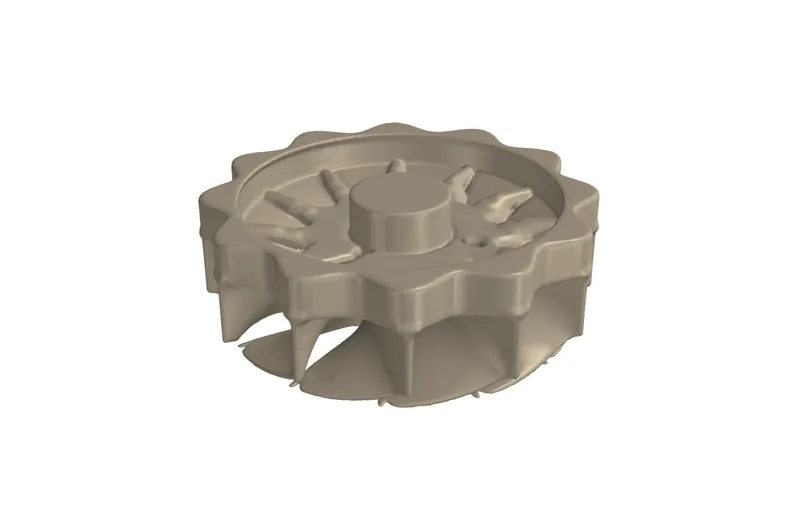
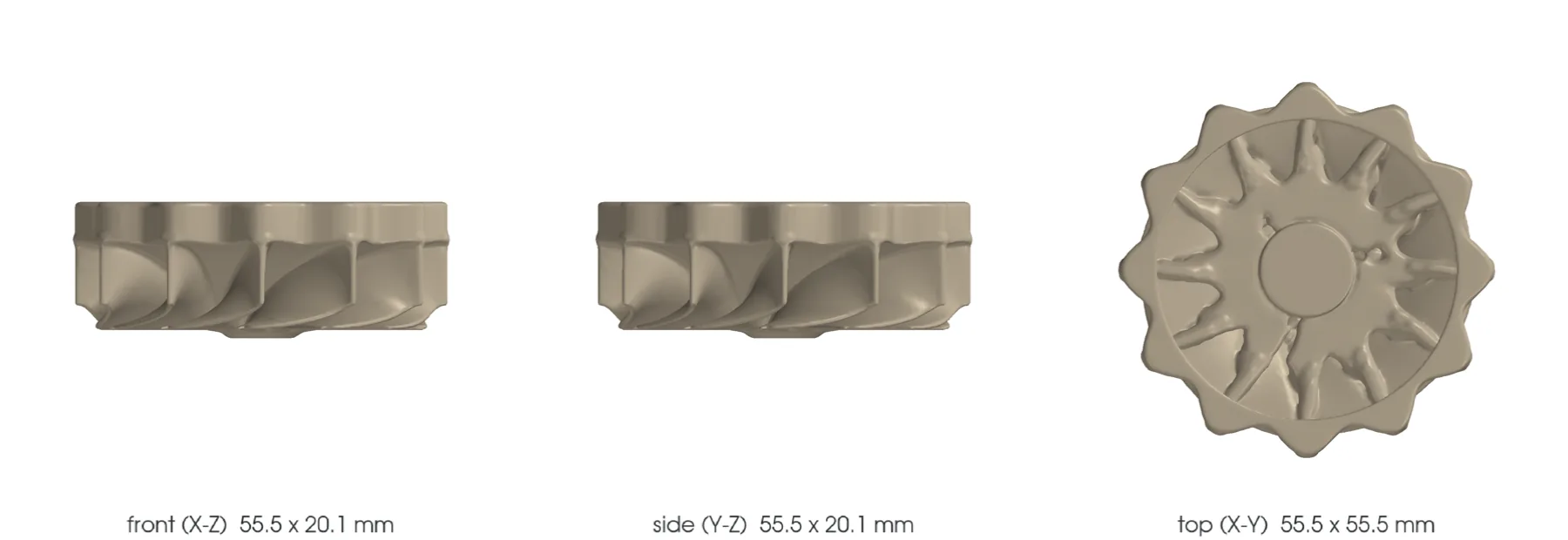
Clean-sheet concept of a twelve-blade K16 hot rotor to screen the value and limits of an IN718 LPBF route. The diameters, blade count and part reference come from supplier catalogues; all profiles and interfaces remain hypothetical.
The design
- Vehicle
- Porsche 993, 1995–1998
- Variants
- 993 Turbo
- Porsche part numbers
- Not recorded
- Category
- Turbocharger turbine wheel
- Geometry basis
- Mixed
- Preferred process
- Not chosen yet
- Other candidate processes
- Laser powder-bed fusion (metal printing), Direct metal laser sintering (metal printing), casting, CNC machining
- Material
- EOS NickelAlloy IN718 API, M290 40 µm, heat treated for comparison
- Material standard
- UNS N07718; program-specific rotor, process, heat treatment and allowables specification to be contracted
Known limits
- Only reference 5316-120-5000, the diameters, twelve blades, tip height and shaft diameter are published, by replacement-part catalogues.
- The 20 mm axial envelope, the disk, the hub and the straight four-step blades are synthetic.
- The STEP excludes the full shaft, the weld, the aerodynamic profiles, fillets, clearances and balancing details.
- The speed of 103,464 rpm comes from the synthetic F1 compressor point, not from a K16 measurement.
- The F0 fails the root and thermal-gradient screens at the 1.5 threshold; the gas context also exceeds the generic range stated by EOS.
- The EOS properties are room-temperature coupons of the API process, not hot HCF, creep or burst allowables.
- The single-point power balance replaces neither a turbine map, nor rotating CFD, nor CHT, nor rotordynamics.
- The STEP proves only a readable BREP and is authorized neither for manufacturing, nor rotation, nor turbo or engine use.
Post-processing it would need
- Blade orientation and supports to be qualified against the recoater
- Traced stress relief, solution treatment, gas quench and aging
- HIP to be decided on defects, creep, toughness, HCF and burst
- Machining of the shaft interface, back face, datums and allowances
- Controlled profiling and polishing of blades and fillets
- Wheel-to-shaft joining process or one-piece shaft to be qualified
- Individual then rotor balancing, spin proof and contained overspeed
What a supplier would have to provide
- Traceable EOS M290 machine, IN718 API parameter set, software, parameters, powder and lot
- Oriented coupons with tensile, HCF, LCF, creep, rupture, toughness and crack growth at temperature
- Distortion witnesses and capability after finishing of the 0.8 mm tips
- Full CT before and after machining with zoned defect criteria
- FPI, metallography, microstructure, hardness, roughness and residual stresses
- Metrology of profiles, fillets, interface, runout and polar inertia
- High-speed balancing, overspeed, burst and containment before turbo bench testing
Sources
- PorscheFanatics - 993 turbocharger context · read
Confirms interest in 993 hot-side upgrades and states that no additive housing or rotor is catalogued.
- TurboMaster - K16 5316-988-6735 · read
Links the right K16 to turbine wheel 5316-120-5000.
- Invasion Auto Products - stated internal data of the right K16 · read
States 54.96/48.97 mm and twelve blades for 5316-120-5000.
- Kinugawa - replacement K16 wheel · read
States 49/55 mm, twelve blades, 9.4 mm height and 8.42 mm shaft for the same reference; no surface or tolerance.
- EOS NickelAlloy IN718 API for EOS M 290, 40 micrometers · read
Process data and room-temperature coupons for the candidate material; no rotor qualification.
- BorgWarner - Performance Turbocharger Catalog · read
993 Turbo context and T3 of 950 °C continuous / 980 °C transient for the upgrade line; this is not the metal temperature of the K16 wheel.