Engine · 993-ENG-K16-COMPRESSOR-WHEEL-AL2139-F1-0001
K16 compressor wheel, Al2139 AM F1 iteration
ConceptNot authorised until engineering review
Iteration of the rejected AlSi10Mg F0, with Al2139 AM and blades of variable root-to-tip thickness. The 40.6/60.5 mm diameters and the 6+6 blade count remain the only published geometric facts; the F1 passes three ambient algebraic screens without becoming a functional wheel.
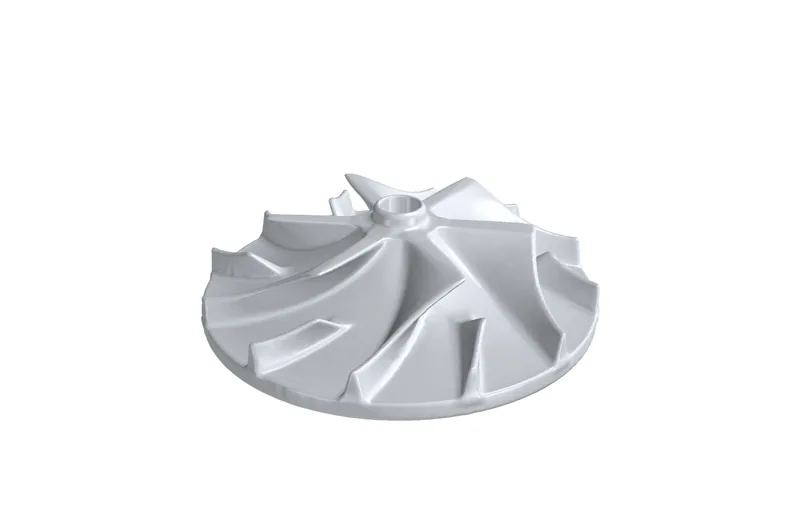
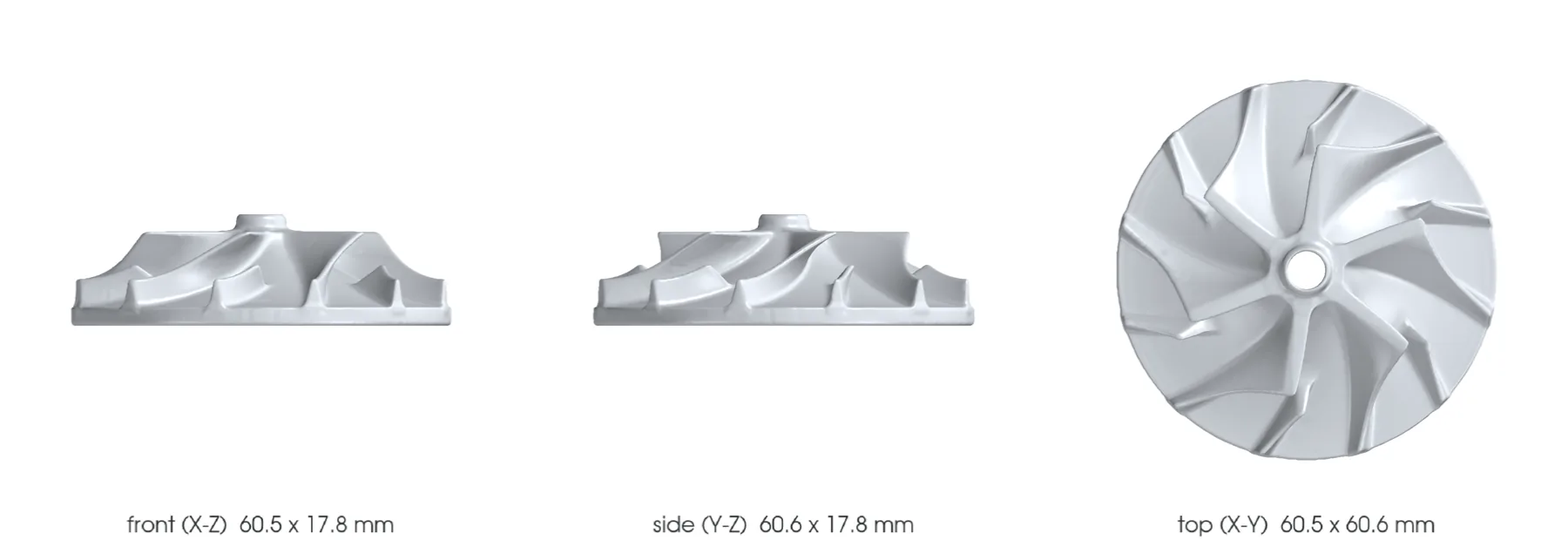
The design
- Vehicle
- Porsche 993, 1995–1998
- Variants
- 993 Turbo, K16 right research, M64 60 research
- Porsche part numbers
- Not recorded
- Category
- Turbocharger compressor wheel iteration
- Geometry basis
- Mixed
- Preferred process
- Laser powder-bed fusion (metal printing)
- Other candidate processes
- Direct metal laser sintering (metal printing), CNC machining, casting
- Material
- EOS Aluminium Al2139 AM, M290 60 µm, heat-treated condition, for comparison
- Material standard
- modified composition of the Aluminum Association Teal Sheet Al2139; program-specific rotor specification to be contracted
Known limits
- The 40.6/60.5 mm diameters, the 6+6 count and the part numbers remain the only published geometric facts.
- The 3.0->0.8 and 2.4->0.8 mm thicknesses are synthetic; the CAD approximates them with four radial segments.
- The 38.49 g CAD mass depends entirely on the F1 and the EOS density, with no comparison to a real K16 wheel.
- The ambient root ratio of 1.986 is an algebraic improvement over the F0's 0.627, not a certified rotor margin.
- The 1.5 criterion, Mach 0.9, 1.2x overspeed and all aerothermal conditions remain regression inputs.
- The 460 MPa value concerns ambient T4 specimens from a TRL 3 process, not HCF or hot burst.
- The radial-segment blades are not aerodynamic; no map, rotating CFD or housing interface is available.
- The STEP proves only a readable BREP; it is authorized neither for manufacturing, nor for rotation, nor for a turbo or an engine.
Post-processing it would need
- Orientation, blade supports and recoater strategy to be qualified
- EOS single-step heat treatment to be contracted with machine, parameters and coupons
- HIP to be decided on defects, toughness, HCF and overspeed results
- Machining of the bore, back face, nose, faces and balancing datums
- Final profiling and controlled aerodynamic finishing of each blade and fillet
- Individual balancing then rotor-assembly balancing, spin proof and contained overspeed
What a supplier would have to provide
- Traceable material set Al2139AM_060_CoreM291_110, machine, software, parameters, powder and lot
- Oriented coupons with tensile, HCF, toughness, crack growth and defects at rotor temperature
- Distortion witnesses and capability of the 0.8 mm tips after finishing
- Full CT before/after machining with defect criteria by zone, and metallography
- Metrology of profiles, thicknesses, fillets, bore, runouts and polar mass
- High-speed balancing, spin proof, overspeed, burst and containment before turbo rig testing
Sources
- Invasion Auto Products - declared internal data of the right-hand 993 Turbo K16 · read
Declares wheel 53241232006, 40.6 mm inducer, 60.5 mm exducer and 6+6 blades. No profile, tolerance, material or process.
- PorscheFanatics - context of 993 turbochargers and wheels · read
Places the twin-turbo system and upgrade wheels, but provides no additive K16 wheel and no geometry.
- EOS Aluminium Al2139 AM for EOS M 290, 60 micrometers · read
Publishes TRL 3, 0.4 mm minimum wall, density >=2.84 g/cm3, mean defects 0.2-0.3% and ambient T4 properties of 460/520 MPa vertical.
- TurboMaster - principles for reading a compressor map · read
Methodology only; no usable K16 map.