Engine · 993-ENG-FAN-HOUSING-ALSI10MG-F0-0001
Stationary engine fan housing, AlSi10Mg F0 concept
ConceptNot authorised until engineering review
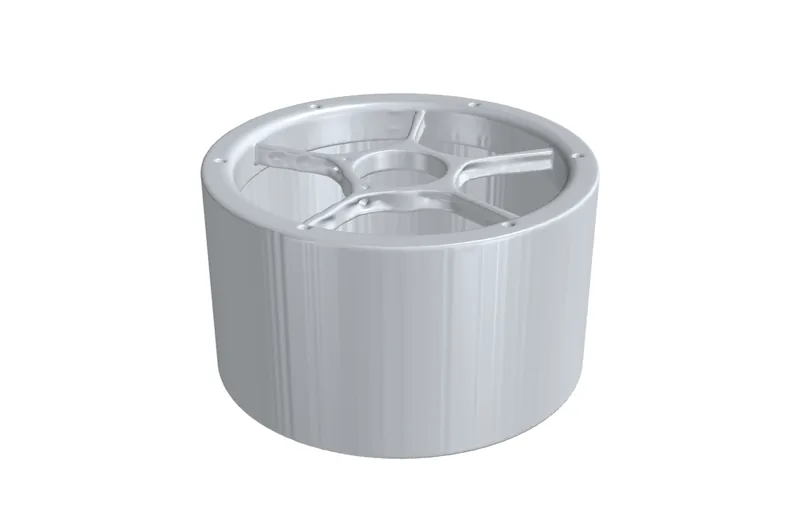
Independent concept of a 993 annular housing combining shell, front flange, alternator support and six spokes. The sources establish the part number, a commercial envelope, two consistent masses and a reseller claim of aluminum, but no interface geometry; the F0 does not reproduce the Porsche part.
The design
- Vehicle
- Porsche 993, 1994–1998
- Variants
- 993 air cooled fitment to confirm
- Porsche part numbers
- 99310666703, 99310666701
- Category
- Engine cooling fan housing
- Geometry basis
- Mixed
- Preferred process
- Not chosen yet
- Other candidate processes
- Laser powder-bed fusion (metal printing), Direct metal laser sintering (metal printing), casting, CNC machining
- Material
- EOS Aluminium AlSi10Mg T6 for comparison; commercial replacement declared only as unspecified aluminum
- Material standard
- DIN EN 1706 EN AC-43000 and ASTM F3318 for the candidate; program-specific cooling, fatigue and containment specification to be contracted
Known limits
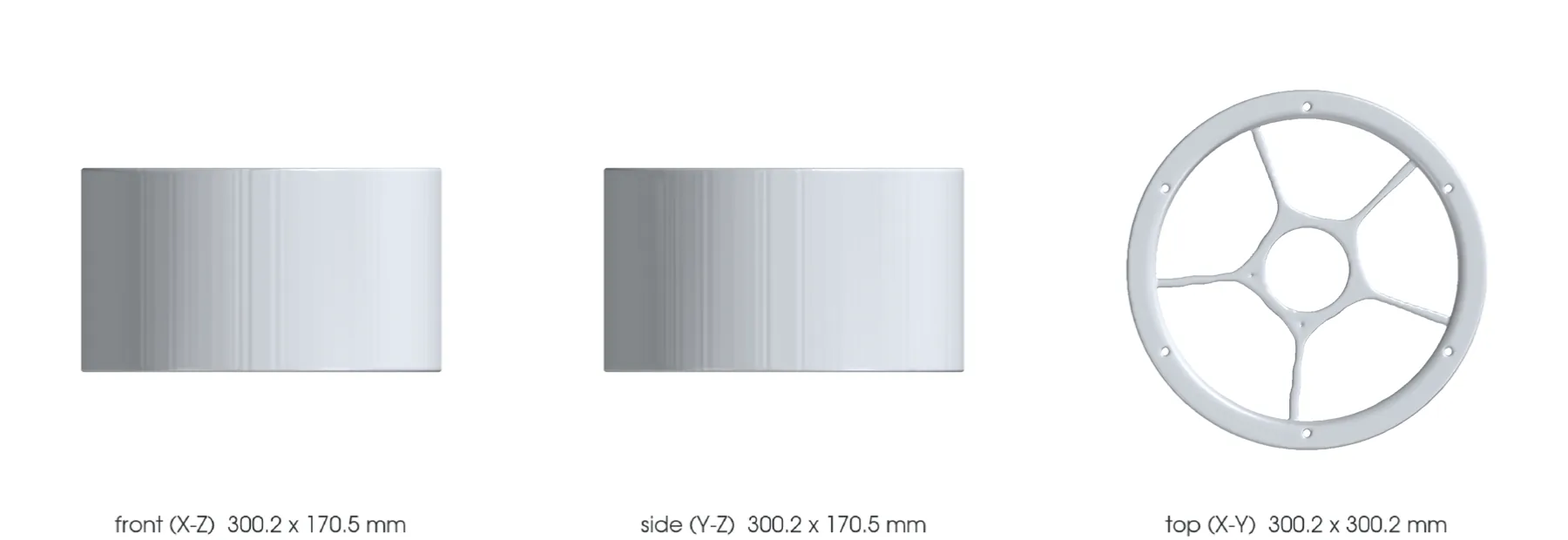
- The 300 x 300 x 170 mm figures are a commercial envelope, not a definition drawing.
- The 1.86/1.9 kg masses are commercial claims with no protocol and no weighing boundary.
- The aluminum material comes with no grade, no process and no certificate; AlSi10Mg remains a candidate.
- The 252 mm diameter, 3 mm shell, 4 mm flange, hub, six spokes and mountings are synthetic.
- The flow, loss, load, speed, blade count and temperature cases are regressions with no 993 authority.
- The constrained thermal screen fails; fatigue, containment and cooling remain non-computable.
- No CFD/CHT, converged FEA, correlated modal, overspeed, vibration or endurance is demonstrated.
- The STEP proves only a re-readable BREP; no manufacturing, rotation or start-up is authorized.
Post-processing it would need
- Orientation and supports of the 300 x 300 x 170 mm ring to be qualified
- Stress relief then T6 with monitored quench and distortion
- HIP to be decided on fatigue, air tightness and tomography results
- Machining of the fan bore, alternator seat, mounting, seal and datums
- Deburring, open depowdering and particle-free duct finishing
- Anti-corrosion treatment compatible with temperatures, fasteners and engine compartment
- Final clearance check before any rotation
What a supplier would have to provide
- Traceable large-platform machine, parameters, orientation, supports, powder and lot
- Oriented coupons with tensile, fatigue, creep and hot corrosion
- Witness samples for annular distortion and duct surface finish
- Full CT, FPI and metallography with zoned defect criteria
- Metrology of bore, concentricity, alternator, mountings, seal and envelope
- Evidence of flow, vibration, overspeed/containment, thermal cycling and engine endurance
Sources
- PorscheFanatics - 993 engine fan housing and airflow · read
Establishes the role of the housing in air distribution and the 993 context, without geometry or material.
- FVD Brombacher - housing 993 106 667 03 · read
Publishes 300 x 300 x 170 mm and 1.9 kg as product data; no interface and no material.
- Centre Porsche Roissy - blower housing 993 106 667 03 · read
Links 993 106 667 03/01 and publishes 1.86 kg, without protocol.
- CarParts - 993 housing declared aluminum · read
Declares aluminum without grade, process or certificate; does not prove AlSi10Mg.
- EOS Aluminium AlSi10Mg material data sheet · read
T6 route and candidate material; numerical values kept as generic comparisons.