Engine · 993-ENG-K16-COMPRESSOR-WHEEL-ALSI10MG-F0-0001
993 K16 compressor wheel, F0 AlSi10Mg LPBF concept
ConceptNot authorised until engineering review
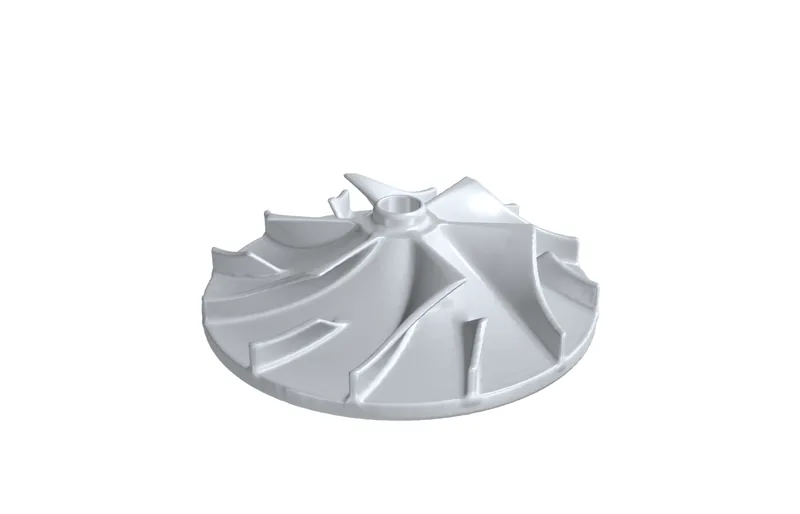
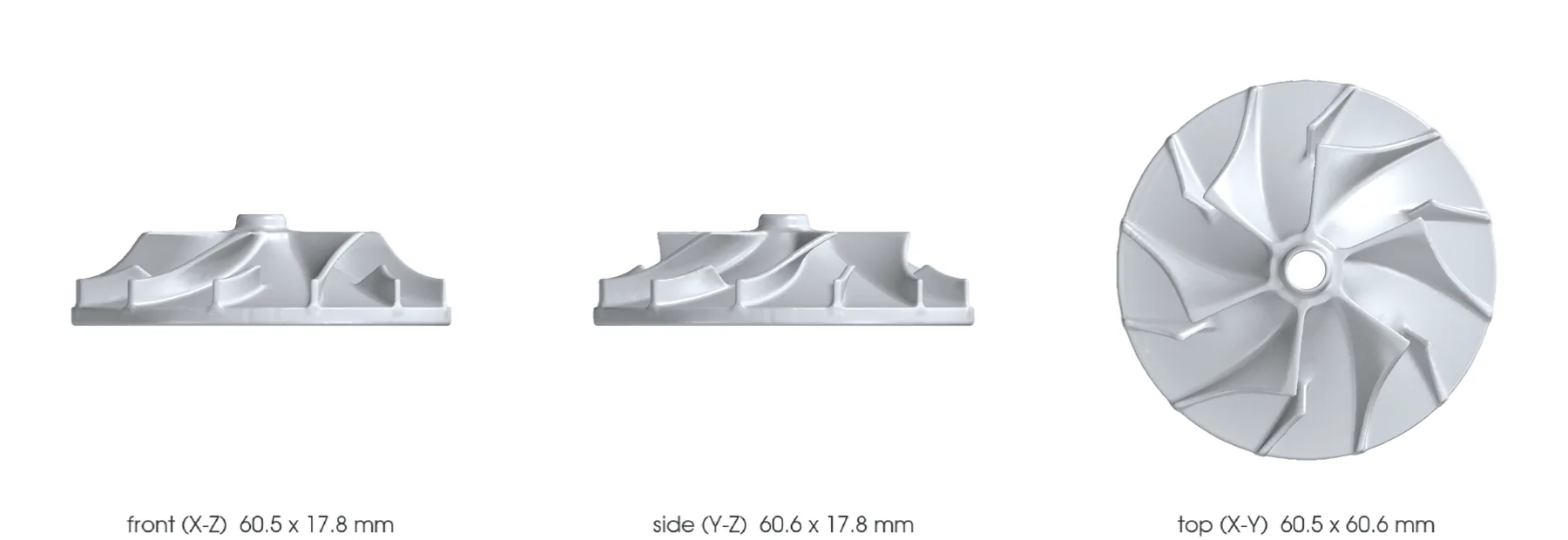
Independent concept of an AlSi10Mg compressor wheel with six main blades and six straight splitters. Only the inducer/exducer diameters, the 6+6 count and the supplier part numbers are published; the hub, the bore and all aerodynamic surfaces remain F0 hypotheses.
The design
- Vehicle
- Porsche 993, 1995–1998
- Variants
- 993 Turbo, K16 right research, M64 60 research
- Porsche part numbers
- Not recorded
- Category
- Turbocharger compressor wheel
- Geometry basis
- Mixed
- Preferred process
- Laser powder-bed fusion (metal printing)
- Other candidate processes
- Direct metal laser sintering (metal printing), CNC machining, casting
- Material
- EOS AlSi10Mg, screening; alloy and process of the BorgWarner wheel not published
- Material standard
- DIN EN 1706 / ASTM F3318 for the powder and a program-specific rotor specification to be contracted
Known limits
- Only the 40.6 mm, 60.5 mm, six main blades, six splitters and the part numbers come from the supplier page.
- The 3 mm disk, 18 mm height, 6 mm bore, the hub and all the straight blades are synthetic.
- The 32.70 g STEP is not comparable to a real K16 wheel; the 4.22 ratio uses a theoretical envelope cylinder, not an industrial blank.
- The 103,464 rpm speed is derived from Mach 0.9 at 330 K, not measured on the K16.
- The 3.6 l, 5,750 rpm, VE 0.95, PR 1.8 and 0.72 efficiency point is a regression case without a compressor map.
- The main blade reaches 390.9 MPa in the overspeed screen, a ratio of 0.63 against the ambient limit: the F0 design fails.
- The disk/blade models ignore real shape, fillets, bore, preload, defects, HCF, rotor dynamics, contact and containment.
- The EOS values are ambient comparisons, not allowables for a printed AlSi10Mg rotor.
- The STEP proves only a readable twelve-blade BREP; it is authorized neither for manufacturing, nor for rotation, nor for a turbo or an engine.
Post-processing it would need
- Orientation, blade supports and recoater strategy to be qualified
- Stress relief and heat treatment qualified for machine, parameters and rotor fatigue
- HIP to be decided on defects, toughness and overspeed results
- Machining of the bore, back face, nose, faces and balancing datums
- Deburring and controlled aerodynamic finishing of each blade and fillet
- Individual balancing then rotor-assembly balancing, spin proof and contained overspeed
What a supplier would have to provide
- Traceable powder, machine, parameters, orientation, lot and recycling
- Oriented coupons with tensile, HCF, toughness, crack growth and defects at temperature
- Distortion simulation and witnesses for blades, exducer, hub and bore
- Full CT before and after machining, defect criteria by zone, and metallography
- Metrology of profiles, thicknesses, fillets, bore, runouts and polar mass
- High-speed balancing, spin proof, overspeed, burst and containment validation before turbo rig testing
Sources
- Invasion Auto Products - declared internal data of the right-hand 993 Turbo K16 · read
Declares wheel 53241232006, 40.6 mm inducer, 60.5 mm exducer and 6+6 blades for the right-hand K16 53169886735. No profile, tolerance, material or process.
- PorscheFanatics - context of 993 turbochargers · read
Confirms the twin-turbo system and the upgrade wheel market, but no LPBF K16 wheel and no geometry.
- EOS Aluminium AlSi10Mg · read
Provides generic LPBF properties that depend on machine, orientation and treatment; no rotor qualification.
- TurboMaster - principles for reading a compressor map · read
Methodological reference only for corrected flow, pressure ratio, efficiency, surge and choke; no usable K16 map.
- elferclassic - 993 Turbo technical data · read
Documents 3.6 liters; the 5,750 rpm speed, volumetric filling, flow and the whole compressor operating point are synthetic.