Engine · 993-ENG-INTAKE-VALVE-TI64-HOLLOW-F0-0001
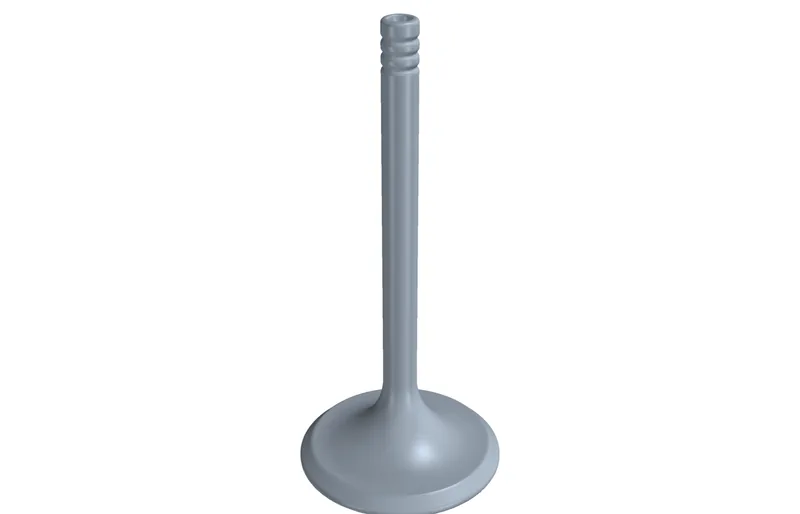
993 hollow Ti64 intake valve, F0 LPBF concept
ConceptNot authorised until engineering review
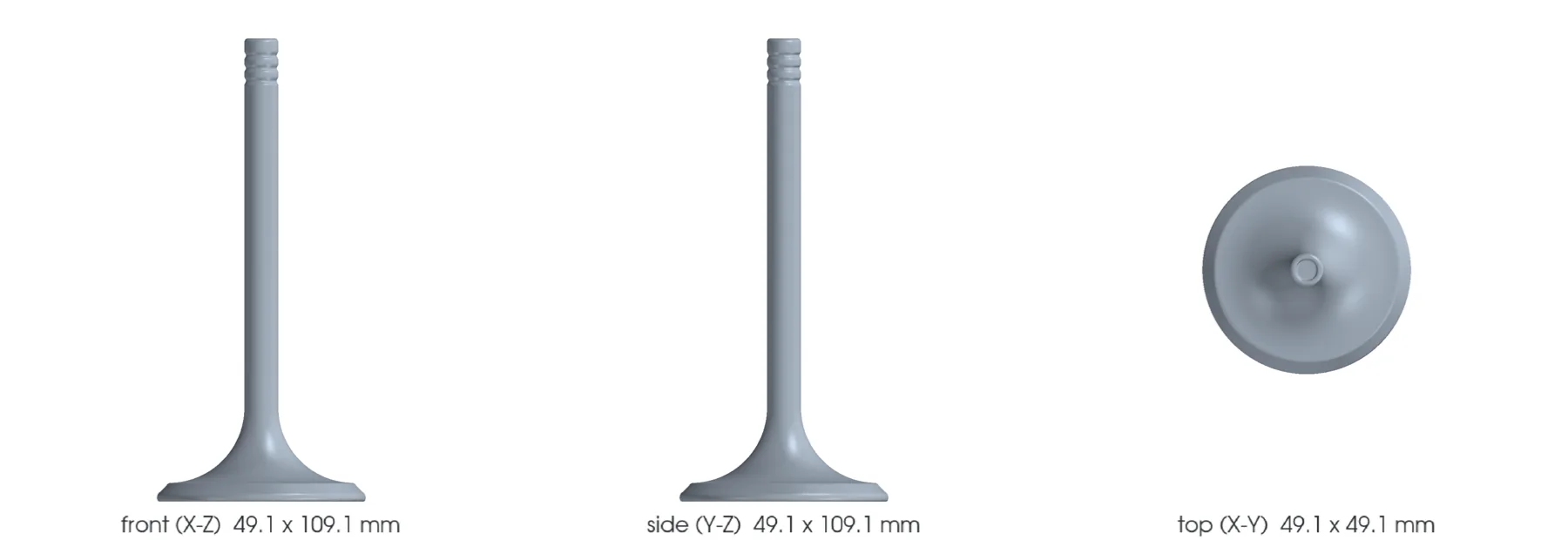
Independent concept of a hollow Ti-6Al-4V intake valve with four internal ribs and an open axial bore for depowdering. Only the head diameter, stem diameter, product envelope, declared mass and part number are published; all functional geometry remains an F0 hypothesis.
The design
- Vehicle
- Porsche 993, 1994–1998
- Variants
- 993 C2, 993 C4, 993 Turbo, M64 research
- Porsche part numbers
- 99310540902
- Category
- Intake valve hollow
- Geometry basis
- Mixed
- Preferred process
- Laser powder-bed fusion (metal printing)
- Other candidate processes
- Direct metal laser sintering (metal printing), CNC machining
- Material
- Ti-6Al-4V Grade 5 LPBF, screening; material of the 993 part number and of the Swindon kit not published
- Material standard
- ASTM F2924 and a program-specific valve specification to be contracted
Known limits
- The 49 mm, 8 mm, 50 x 110 x 50 mm, 120 g and the part number come from a commercial product page with no drawing or independent measurement.
- The 109 mm length, the head, neck, cavity, 5 mm bore and four 1.2 mm ribs are entirely synthetic.
- The 55.45 g CAD mass and the 23.38% saving compare two F0 designs sharing the same invented exterior; they do not validate a saving over OEM.
- The 12 mm lift, 240 crank degrees, 520 N + 40 N/mm spring, 0.20 MPa and +400 K are unmeasured regression cases.
- The first mode at 190.8 Hz is a cantilever beam screen, not a modal analysis of the guide-seat-spring-cam system.
- The section, Euler and circular plate stresses ignore contacts, impact, valve float, groove, defects and multiaxial fatigue.
- The EOS/TIMET values are ambient and physical comparisons, not hot LPBF valve allowables.
- The STEP proves only a readable BREP with an open cavity; it is authorized neither for manufacturing, nor for installation, nor for an engine.
Post-processing it would need
- Vertical-axis orientation and support strategy to be qualified
- Documented depowdering of the cavity through the open axial bore
- Stress relief and heat treatment qualified for the machine and parameters
- HIP to be decided on the defect population and representative fatigue
- Closure of the end by a process to be defined, then CT and proof test
- Machining and finishing of the stem, seat, groove, head and datums
- Coating, tip hardness, guide-seat matching and clearance balancing
What a supplier would have to provide
- Traceable powder, machine, parameters, orientation, lot and recycling
- Oriented coupons with tensile, HCF/LCF, impact, creep, oxidation, wear and alpha case at temperature
- Proof of depowdering of the 5 mm bore over about 100 mm and an internal cleanliness criterion
- Qualification of the end closure, its sealing and its retention
- Full CT, metallography, penetrant testing and metrology after all post-processing
- Full-scale valve tests on a hot rig, a motored cylinder head, then an engine before the vehicle
Titanium route
- Alloy
- Ti-6Al-4V Grade 5 candidate only; no grade is established for Porsche part number 99310540902
- Heat treatment
- EOS stress-relief and ductility treatment to be qualified; no recipe frozen without machine, orientation, coupons and closure
- Hot isostatic pressing
- To be determined
- CT of the head, ribs, bore, closure and transitions
- Metrology of length, diameter, straightness, runout, seat and groove
- Roughness, porosity, alpha case, residual stresses and internal cleanliness
- Penetrant testing after machining and inspection of the closure
- Hot impact, bounce, wear, fatigue and retention tests
Sources
- FVD - declared 993 intake valve dimensions · read
Declares a 49 mm head, 8 mm stem, 120 g mass, 50 x 110 x 50 mm envelope and part number 99310540902. No profile, material, treatment or tolerance.
- PorscheFanatics - titanium valve context for the 993 engine · read
Identifies titanium valves in the Swindon four-valve system; proves neither a grade, nor a shape, nor compatibility with the two-valve M64 valve.
- EOS Titanium Ti64 Grade 5 · read
Provides typical LPBF properties that depend on machine, orientation and treatment; no valve validation.
- TIMETAL 6-4 physical properties · read
Wrought density, modulus, expansion, conductivity and specific heat are used for physical screening only.
- elferclassic - 993 Turbo technical data · read
The 6,720 rpm limiter provides only a documentary speed bound; the cam law, spring, pressures and temperatures remain synthetic.