Body · 993-BODY-FRONT-IMPACT-SUPPORT-ALSI10MG-F0-0001
993 front impact support, AlSi10Mg graded-core concept F0
ConceptNot authorised until engineering review
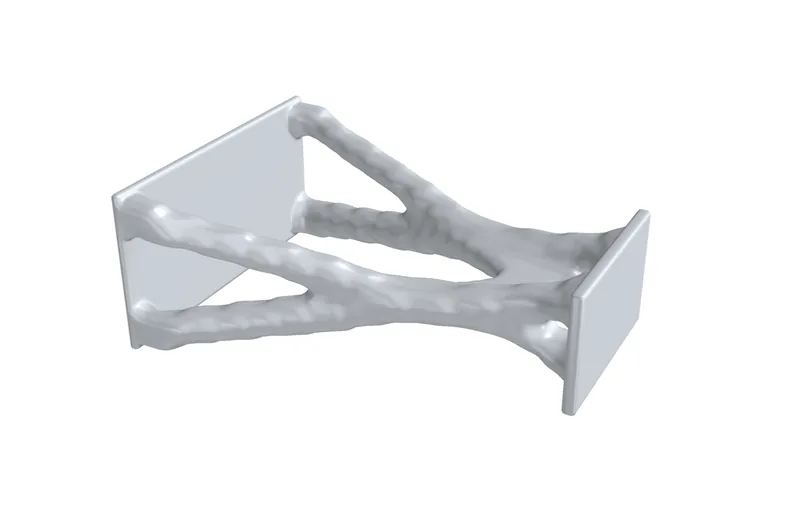
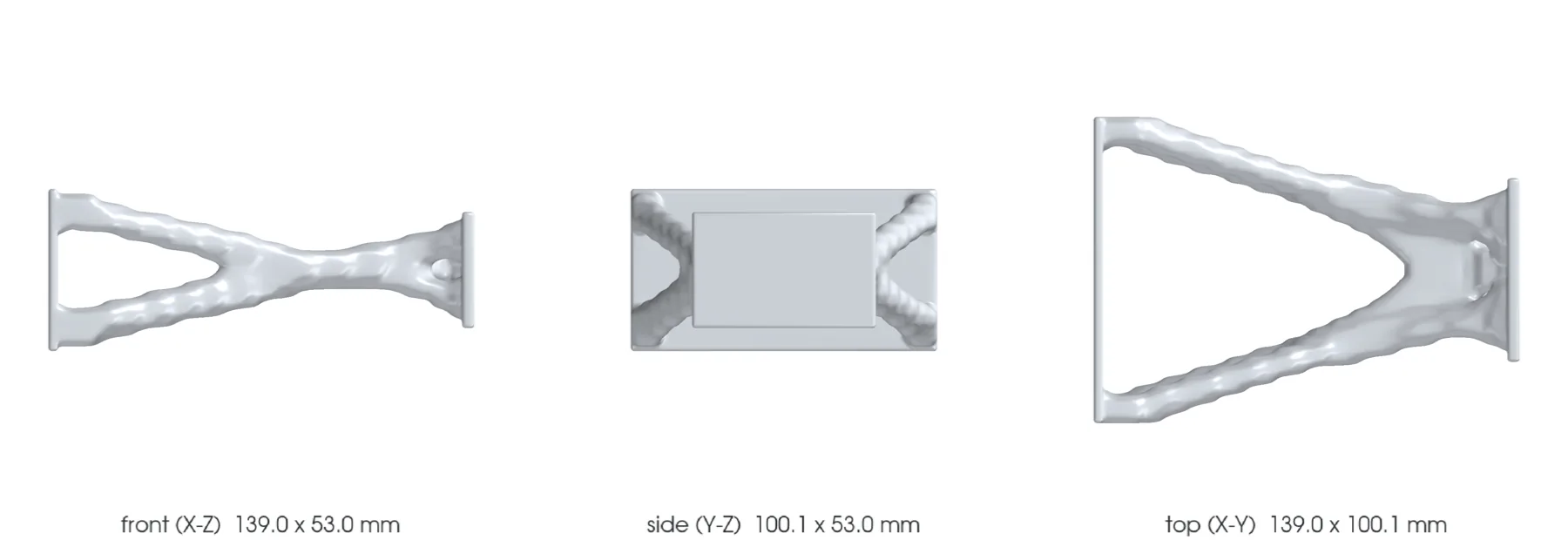
Independent front support concept with an elliptical shell and a graded open cruciform core, used to screen the value of LPBF AlSi10Mg. PorscheFanatics corroborates the lightweight FVD support at 145 g; FVD publishes a 139 x 100 x 53 mm envelope and states only aluminum, with no alloy and no interface geometry.
The design
- Vehicle
- Porsche 993, 1994–1998
- Variants
- 993 Carrera, 993 Turbo, 993 GT2
- Porsche part numbers
- Not recorded
- Category
- Front bumper impact support
- Geometry basis
- Mixed
- Preferred process
- Not chosen yet
- Other candidate processes
- Laser powder-bed fusion (metal printing), Direct metal laser sintering (metal printing), CNC machining, sheet_metal
- Material
- generic screening AlSi10Mg; alloy and temper of the FVD product unknown
- Material standard
- ASTM F3318 and a program-specific crash specification to be contracted if LPBF is retained
Known limits
- Only the 139 x 100 x 53 mm envelope, the 145 g mass and the aluminum family are published; any F0 topology is hypothetical.
- No hole or boss is modeled because no body shell or bumper interface has been measured.
- The 144.65 g of the STEP, close to the commercial 145 g, is a designed scalar check, not a geometric validation.
- The 15 kN over 80 mm load case and its 6.55 km/h equivalent are synthetic and match no regulatory procedure.
- The elastic and plate calculations predict neither progressive folding, fracture, impulse, intrusion nor occupant protection.
- The STEP proves only a computable BREP; any manufacture, installation or road use is prohibited at this stage.
Post-processing it would need
- Complete powder removal through the four open channels
- Stress relief and heat treatment qualified on representative coupons
- Build plate cut-off without initiating cracks in the crush walls
- Interface machining only after measurement and addition of machining stock
- Deburring without removing the folding triggers defined by the future calculation
- Galvanic and corrosion protection to be defined with the bumper and the body shell
What a supplier would have to provide
- Traceable powder, machine, parameters, orientation, batch and recycling
- Capability demonstrated on a 1.2 mm shell and a core graded down to 0.8 mm
- Coupons in the part orientations with quasi-static and dynamic tensile tests
- Distortion simulation, support strategy and recoater check before launch
- CT of the shell and the core, full metrology and dye-penetrant inspection after finishing
- Quasi-static and dynamic force-displacement curves on representative batches
- Subsystem then vehicle validation by a qualified crash engineer
Sources
- PorscheFanatics - lightweight 993 front bumper support · read
Corroborates the FVD product name, its front left/right position and 0.145 kg; no geometry and no crash validation.
- FVD - 993 aluminum front impact support · read
Commercial claims of 139 x 100 x 53 mm, about 145 g and aluminum; direct access blocked during collection, no drawing and no protocol.
- EOS Aluminium AlSi10Mg material page · read
Process and material-family reference, not a crash allowables card and not evidence of the FVD alloy.