Porsche Parts · PicoGK · original concept
F1 geometry · no validated aerodynamic gain
A turbo in 39 pieces.
One volute to compare.
The first branching compressor housing has grown into a complete concept assembly. F1 changes the compressor volute while keeping the other 38 components identical, giving the next comparison a clear question: does this passage move more air at the same conditions?
Reviewed through · functional manufacture not released
01 / The object
Assembled, exploded, inspectable
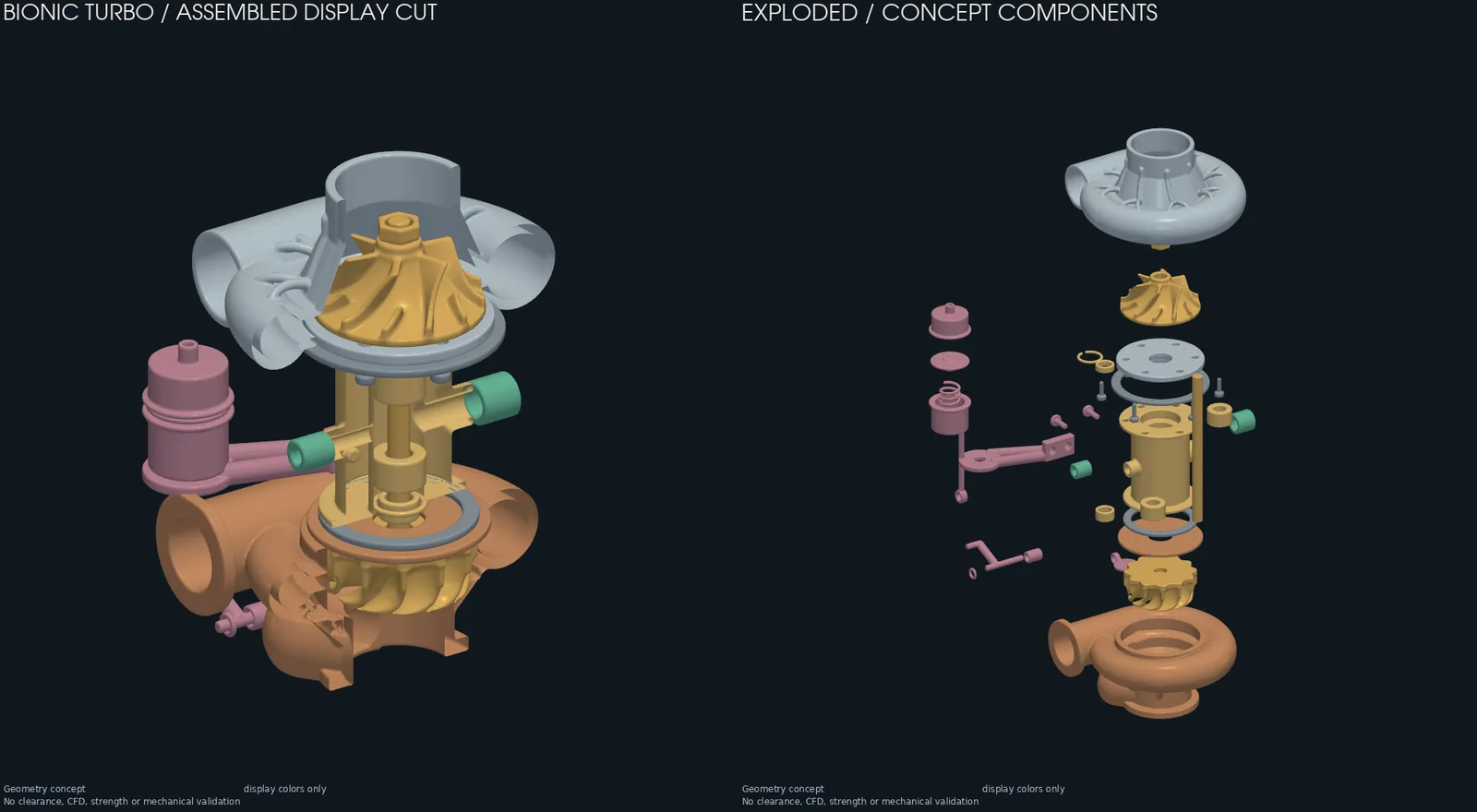
The editable masters are PicoGK code and parameter files. Separate meshes and assembled and exploded scenes preserve the component identities. Closed meshes establish an inspectable shape; the bearings, oil circuit, seals, hot clearances and attachment interfaces still need engineering definition.
02 / The change
A different growth law for the volute
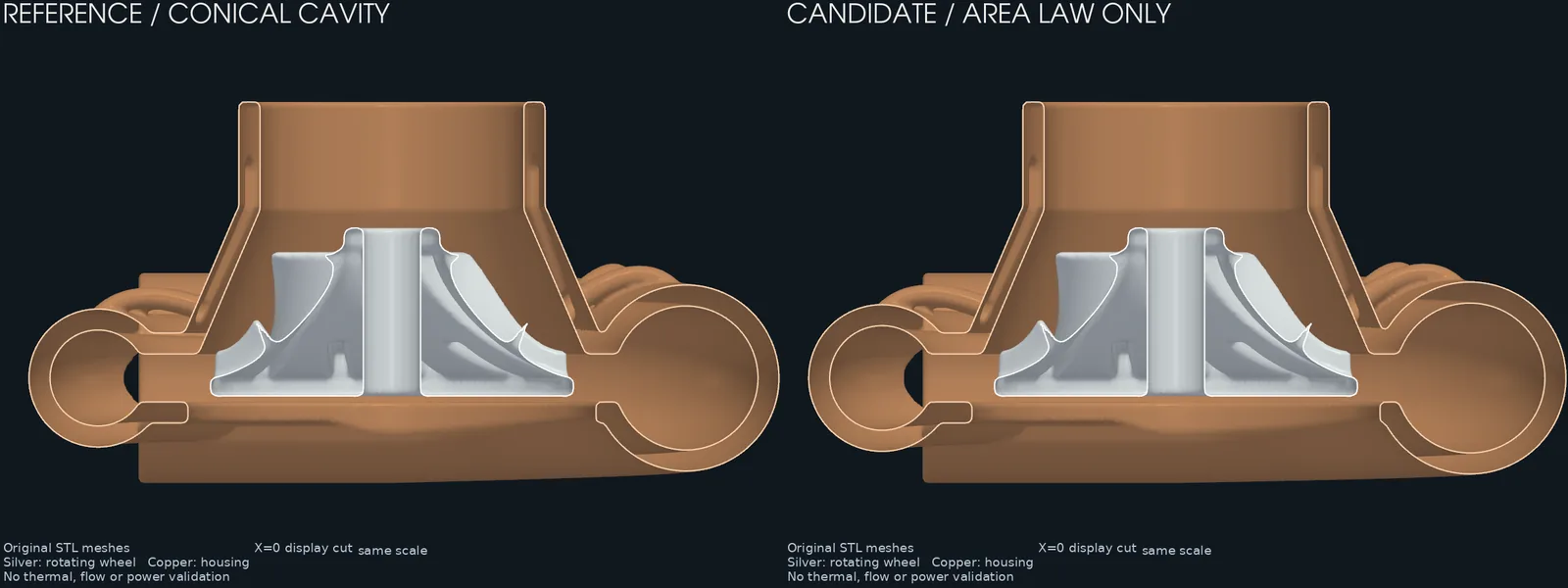
F0 increases the nominal passage radius linearly around the wheel. F1 increases its nominal area linearly, with the same end radii. That geometric rule is a candidate for comparison, not a measured flow law. A second version bringing the housing closer to the wheel was rejected for the current CFD study because its local clearance was below the geometric resolution.
03 / The evidence
The CFD trials have not settled the comparison
Work through 12 October has retained failed startup histories, corrected fluid passages and boundary labels, and tested the interface between rotating and stationary regions. Control cases exposed spurious flow at stepped interfaces. Later interface witnesses and structured background meshes help diagnose that error; the physical turbo mesh trials remain rejected. The newest conformal-transition witness passes native mesh admission and a bounded stationary-gas test on a synthetic annulus. It contains no turbo wheel, blade or inlet/outlet, and its pressure solves reach their iteration limit. This is a numerical witness, not an admitted physical turbo calculation or a qualified convergence result.
The 13 October work moves from single meshes to a parametrised family: a synthetic 6,144-cell transition between rotating and stationary regions, without rotor or physical ports, in which one ring radius stays at its source value while another varies across 153 preserved closed intervals. Independently checked interval bounds now cover native cell volume, face weights, skewness and orthogonality on that family. All 1,453,440 orthogonality bounds are read back independently; some remain undecided. Positive bounds for one expression do not admit a mesh or select a physical candidate.
The face-tetrahedron check that was still open is now bounded on the same intervals. It applies the expressions of the solver’s native test, which splits every face and cell into signed tetrahedra and needs a common base vertex on both sides of each internal face. Over the whole range, 9,168 of the 18,560 faces passed and 9,392 were undecided, with no certain failure; rechecked interval by interval, all 1,436,976 local cases passed, so every interval now passes for all 18,560 faces. An independent reader at higher precision confirmed every claimed sign and all 59,004,384 finite intervals; 141,608 tetrahedron records without numerical bounds stay undecided and claim nothing. This shows that a valid base vertex exists on each whole interval, not that the solver would choose that vertex first. A first version of one reference checker failed during preparation on a programming error; it is kept, and its one-line correction preceded any turbo calculation.
A second package, published in French on 13 October and rerun in English on 14 October with byte-identical programs and identical counts, addresses contacts between cells. A written proof, whose finite combinatorial hypotheses two separate programs check, shows that in the shared tetrahedral representation used by the earlier proofs, two cells meet only along the faces, edges or vertices they share, for every value in the closed range. Of 18,871,296 pairs of distinct cells, 13,696 share a face, 34,048 an edge but no face, and 34,816 only vertices; the other 18,788,736 pairs do not touch, not even at a point. The programs check the hypotheses, not the reasoning: the proof is not machine-checked. The English rerun counted fewer turbo tests than the original run (82 against 109); that difference has not been investigated.
Both results stay narrow. They hold for this synthetic family with one radius fixed, and the contact proof uses auxiliary centre points that are not the solver’s native cell centres; neither transfers to another native triangulation or to the physical turbo surfaces. The constants assume double precision; floating-point accumulation, the conversion of exact values to the 16-digit text the solver reads, its effective configuration and its binary all remain open, and are the next prescribed step. Two intervals with undecided determinants are still kept. No candidate, native mesh or solver run was launched, and no new physical turbo solve is accepted.
No accepted paired CFD result yet establishes a gain in airflow, shaft power or efficiency. Saved native fields and checked archive hashes make the attempts reviewable, but do not turn a failed calculation into a performance result.
The next decision
- Qualify the floating-point conversion, configuration and solver binary behind these bounds, then admit the physical meshes and rotating-frame interface at unchanged quality criteria.
- Compare reference and F1 at the same speed and pressure conditions, with conservation and convergence checks.
- Establish compressor and turbine maps, shaft power balance and measured engine matching.
- Qualify interfaces, material, balance, overspeed and fatigue before any functional build.