Porsche 993 Turbo · PicoGK · engine support system
Shape study · fit and mechanical behaviour unverified
Branches around a load path.
The isolator stays separate.
The titanium carrier study now has neighbouring concepts: a central bracket, two open mount cages and two flexible envelopes. Each has a distinct role. A metal cage cannot stand in for a working rubber mount.
Geometry study from
01 / The shapes
An open bracket and two mount cages
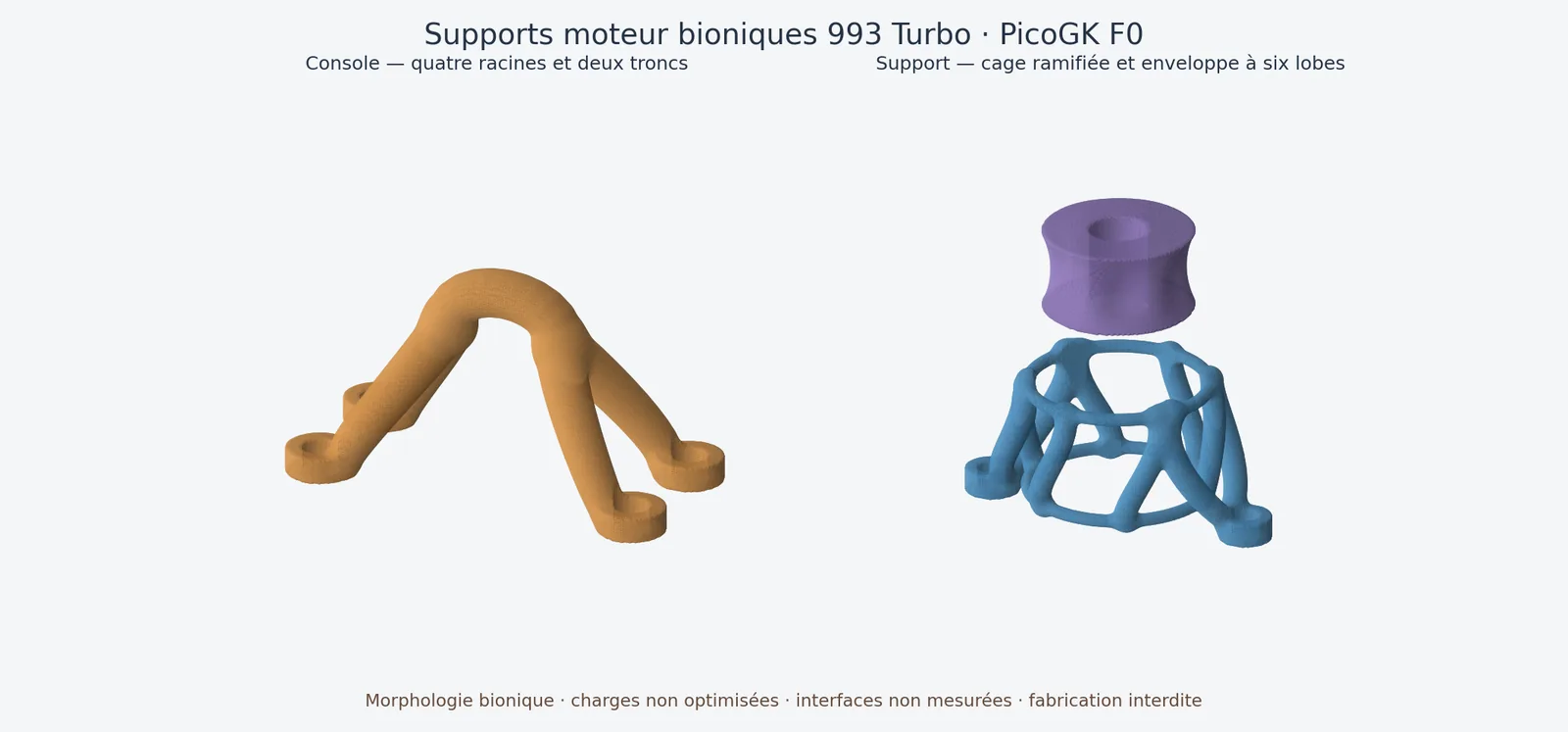
The bracket branches from four collars into two curved trunks and a crown. The mount housing uses curved branches around an open receiving volume. A separate six-lobed envelope reserves space for the flexible element; its material, internal mechanism, stiffness and damping remain unknown.
| PET reference | Role | Study |
|---|---|---|
| 993 115 021 53 | Turbo engine carrier | Existing R9 study; kept separately |
| 993 115 103 52 | Central bracket | New branching shape study |
| 993 375 049 05 × 2 | Engine mounts | Open cages and separate isolator envelopes |
Read the existing titanium carrier R9 study. Carrera and RS carriers remain separate variants.
02 / What is established
Geometry checked; interfaces still unknown
The three distinct meshes pass independent checks of closed edges, consistent orientation, positive volume and a single connected component, with source and export hashes retained. The scene uses millimetres. These checks do not establish fit, strength, fatigue or all possible self-intersections.
“Bionic” names the branching morphology. No structural solver has justified the material distribution, and no topology optimisation or mechanical improvement is claimed.
What comes next
- Measure the bracket, carrier and body interfaces independently.
- Define engine loads and the required isolation and damping behaviour.
- Check fasteners, contact, strength, modes and fatigue using qualified material data.
- Review manufacture and physical tests before releasing a functional part.