Engine · 993-TURBOCHARGER-K16-PAIR-0001
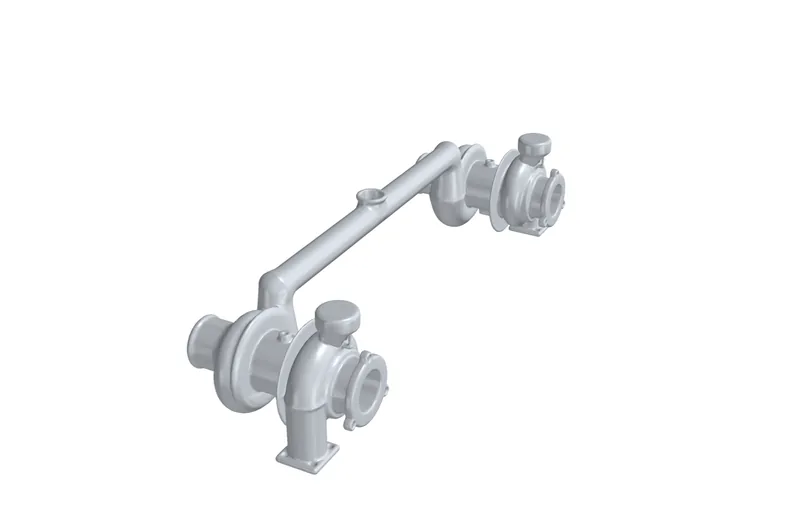
Pair of K16 turbochargers of the 993 Turbo
ConceptNot authorised until engineering review
Research target of the digital twin: two K16 turbochargers mounted in parallel on the 993 Turbo. This record establishes the functional identity and the available public data; it constitutes neither a replacement geometry nor a manufacturing authorization.
The design
- Vehicle
- Porsche 993, 1995–1998
- Variants
- 993 Turbo
- Porsche part numbers
- 993 123 013 51, 993 123 013 52, 993 123 014 51, 993 123 014 52
- Category
- Turbocharger
- Geometry basis
- Estimated
- Preferred process
- Not chosen yet
- Other candidate processes
- Laser powder-bed fusion (metal printing), CNC machining, casting
- Material
- undetermined
- Material standard
- none
Known limits
- No K16 unit, K16 data plate, K16 physical measurement, K16 scan or licensed K16 CAD is available in the project; K16 masses and envelopes are now available as supplier declarations, without tolerances or interfaces.
- The left/right part numbers come from public cross-references and must be confirmed on a part or in an authorized Porsche source.
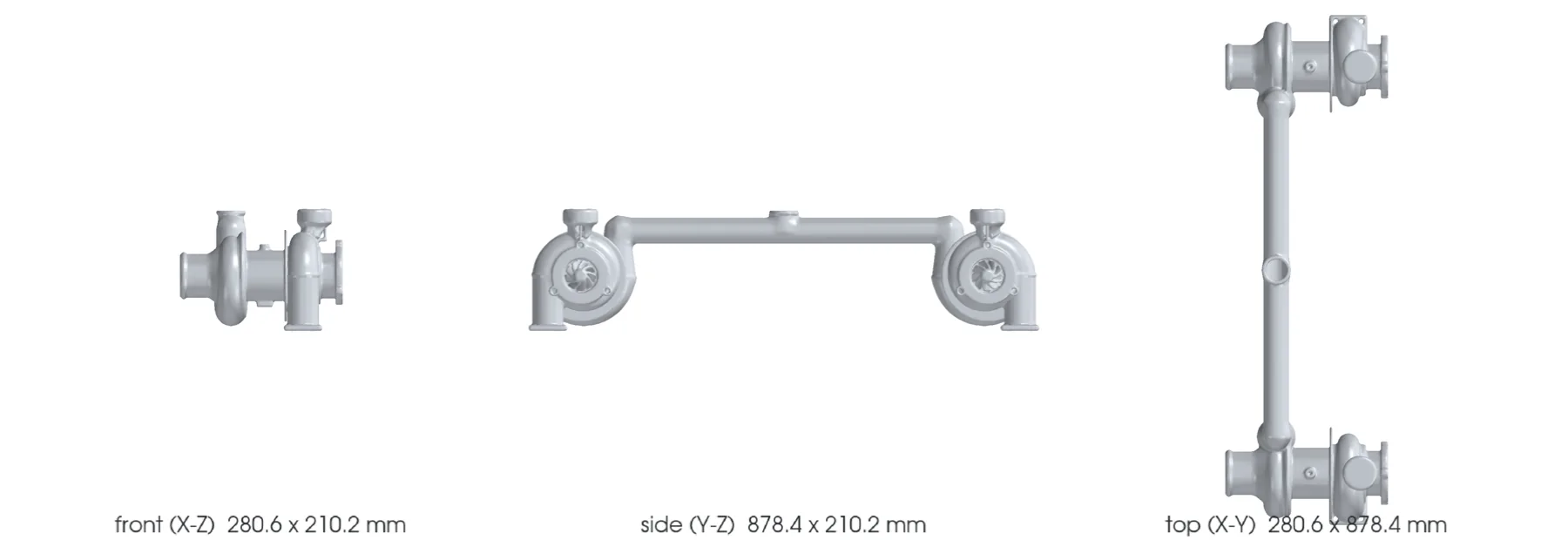
- FVD declares 5.76 kg for the left-hand K16 and 5.6 kg for the right-hand K16, with a product envelope of 280 x 190 x 210 mm; these values serve the envelope and mass check, not the reconstruction of the bare turbo.
- Invasion Auto Products declares wheel diameters for the right-hand K16 (turbine 54.96/48.97 mm; compressor 40.6/60.5 mm), part numbers and an A/R of 8; these values must be confirmed before any wheel geometry or rotordynamic calculation.
- No compressor/turbine map, efficiency curve, mass flow, maximum speed, tip clearance, axial/radial play, oil pressure or turbine inlet temperature has been collected.
- The part numbers for wheels, housings, CHRA, actuator and A/R are supplier catalog declarations; they define neither the aero surfaces nor the tolerances.
- The local Porsche 993 manual is a source of service procedures and specifications; it does not provide a complete CAD definition of the K16 here.
- The Porsche Fanatics transcription adds a PET bill of materials for groups 202-16, 107-20 and 107-45, but no new dimensional measurement; the listed lines must be read in context before any fitment conclusion.
- A turbine wheel, a compressor wheel, a shaft, a bearing or a hot housing are loaded, thermal and/or rotating parts: no printing, fitment, engine test or road use is authorized by this record.
- The twin's first demonstrator must target a non-rotating cold-side duct or adapter, with an envelope prototype before any metal version.
Post-processing it would need
- To be defined after geometry and material
- Machining of the interfaces and bearing faces
- Balancing of the rotating assembly if a rotor is studied
- Dimensional and non-destructive inspection
What a supplier would have to provide
- Process qualification and lot traceability
- Thermal, fatigue, rotordynamics and pressure dossier
- Metrology and non-destructive testing report
- High-speed balancing by a qualified operator
- Formal engineering review before any engine test
Sources
- Porsche Christophorus - Technical data of the 911 Turbo (993) · read
Parallel twin-turbo architecture, 3,600 cm3, 0.8 bar, 408 hp, 540 Nm and integrated wastegate.
- BorgWarner - Performance Turbocharger Catalog · read
Commercial association of the 993 Turbo with the K16-6735 and K16-6736; no complete geometry.
- FVD Brombacher - envelope and mass of the 993 K16s · read
Product declarations: 280 x 190 x 210 mm and 5.6 kg for the right-hand K16 99312301452; the left-hand page 99312301352 states 5.76 kg with the same envelope.
- Invasion Auto Products - internal catalog data of the right-hand K16 · read
Declarations of part numbers, inducer/exducer diameters, housing clocking angles, A/R and wastegate setting for 53169886735; no aero surface, tolerance or CAD.
- Design911 - Cross-reference of the 993 Turbo K16 turbochargers · read
Left/right Porsche and BorgWarner cross-reference, to be confirmed on a turbo data plate or a primary source.
- TurboMaster - Exploded parts view of the BorgWarner K16 5316-988-6735 · read
Subassembly part numbers and declared A/R; no metrology drawing.
- Porsche Fanatics - PET transcription of the 993 turbo groups · read
The site's local repository exposes PET groups 202-16, 107-20 and 107-45: bill of materials for the turbochargers, lines, control, forced induction and intercooler. The lines are PET transcriptions, with no dimensions, tolerances or CAD.
- Porsche Austria - PET 993, group 107-45 air cooler · read
Official PET plate used to cross-check the part numbers, fittings, gaskets and clamps of the forced induction circuit; it provides no passage dimensions and no CAD.
- TurboMaster - K16 gauche 5316-988-6736 de 993 Turbo · read
Live-checked 2026-09-27: confirms left unit = 5316-988-6736 (OEM 99312301351-52-3CX), left bearing housing 5316-151-0008 distinct from right 5316-151-0002, A/R 8.0 and CHRA 5316-710-0520 cross-checked.