Interior · 993-INT-DOOR-OPENER-LEVER-F0-0001
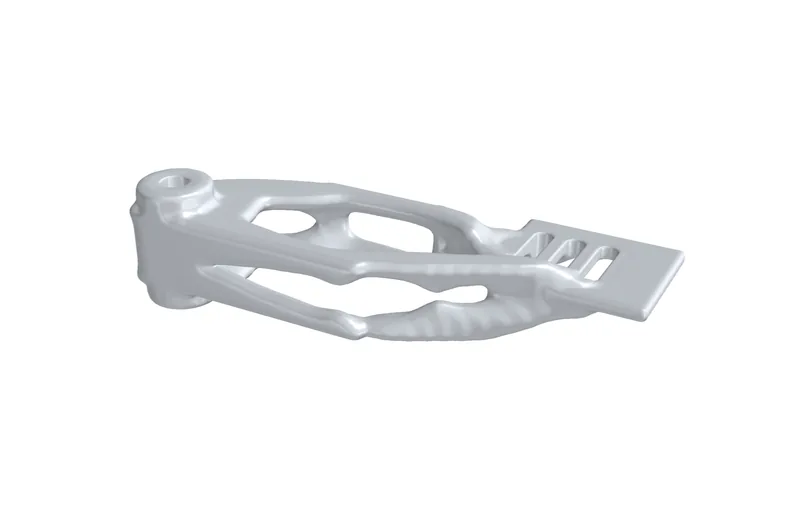
993 interior door opener lever, aluminium F0 concept
ConceptFunctional part
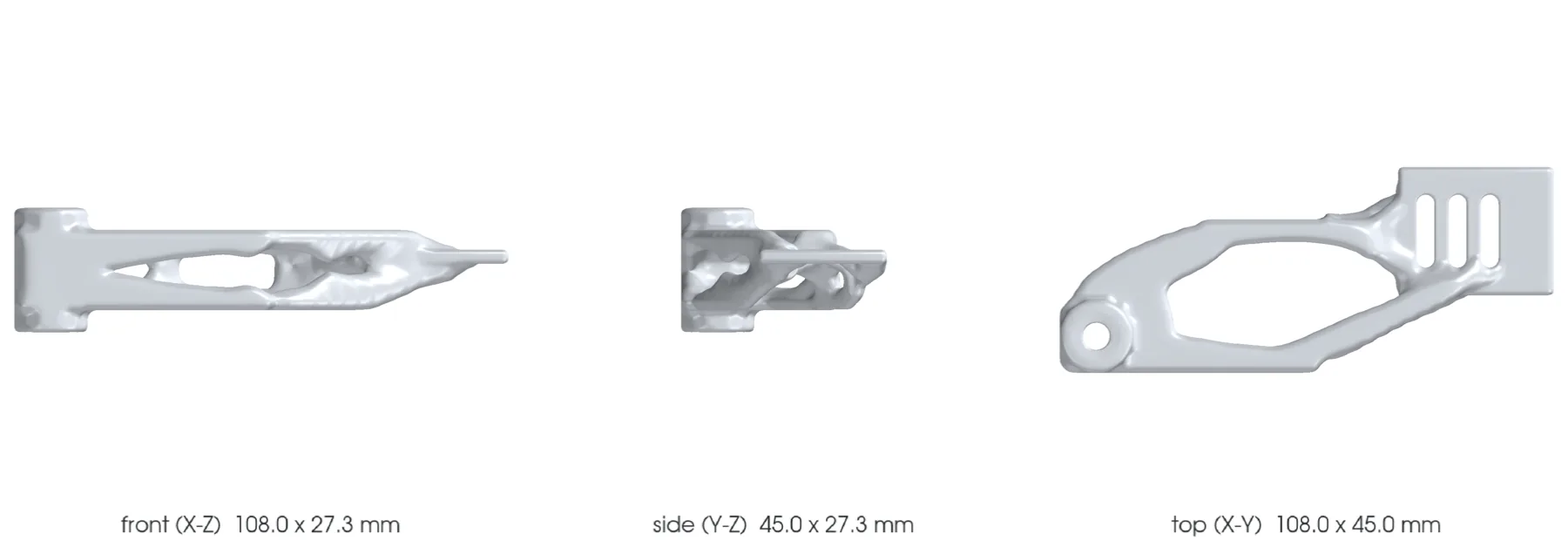
Independent concept of an integrated lever and clevis for studying a low-volume LPBF remanufacture. PorscheFanatics establishes the left and right PET part numbers; FVD publishes the envelope and mass of an aftermarket pair, but no interface geometry allows fitment.
The design
- Vehicle
- Porsche 993, 1994–1998
- Variants
- 993 door trim variants to confirm
- Porsche part numbers
- 99355585100, 99355585200
- Category
- Interior door release
- Geometry basis
- Mixed
- Preferred process
- Laser powder-bed fusion (metal printing)
- Other candidate processes
- CNC machining
- Material
- AlSi10Mg, screening; OEM material and grade of the commercial product unknown
- Material standard
- ASTM F3318-18 to be contracted if the concept progresses
Known limits
- Only the 108 x 45 x 27 mm envelope comes from the commercial product page; the plate, pockets, clevis and bores are F0 hypotheses.
- The published mass of 0.18 kg concerns the complete commercial pair and does not validate the mass of the concept.
- The 150 N and +60 K case is synthetic; no 993 load, direction, stop or temperature has been measured.
- The nominal calculation ignores real contact, LPBF defects, pin clearance, preload, coating, corrosion and aging.
- The CalculiX screen uses six synthetic cases and a Goodman comparison of coupons; it computes no part life.
- The geometric slicing is neither an EOSPRINT job nor a melt-pool, distortion or recoater calculation.
- The asset and the scene pass minimal USD validation and an ovphysx smoke test; the Content Agents, the full SimReady profile, OVRTX and the door assembly have not been run.
- The STEP proves only a computable BREP within the envelope; it must be neither printed for fitment nor installed in a door.
Post-processing it would need
- Support removal while keeping access to the pockets
- Heat treatment qualified for the machine and orientation
- Boring and finishing of the pivot after the clearance is defined
- Machining of the mounting faces with a future machining allowance
- Anodizing or powder coating after dimensional inspection
What a supplier would have to provide
- Traceable powder, machine, parameters, orientation and lot
- Witness coupon in the critical orientation of the lever
- Dimensional inspection of the envelope, pivot, mounting faces and stops
- CT or radiography of the clevis and penetrant testing after machining
- Controlled roughness and radii in the grip areas
- Instrumented static and cyclic tests before any fitment
Sources
- PorscheFanatics - PET part numbers of the 993 interior door openers · read
The dataset at commit 4192f9699f1176bcfe8b8ec7cbcc7c05dc7ee296 identifies 993 555 851 00 and 993 555 852 00 as door opener at PET positions 807-10/807-11. It provides no dimension.
- FVD - aluminum door opener set FVD55599301B · read
FVD declares 108 x 45 x 27 mm, 0.18 kg per pair, anodized or powder-coated high-strength aluminum and original fasteners. These values are a product envelope, not an OEM definition.
- EOS Aluminium AlSi10Mg material data sheet · read
Ambient screening map only; the grade of the FVD product is unknown and no equivalence is claimed.