Exhaust · 993-EXH-OVAL-TIP-IN625-F0-0001
993 oval exhaust tip, IN625 double-wall F0 concept
ConceptFunctional part
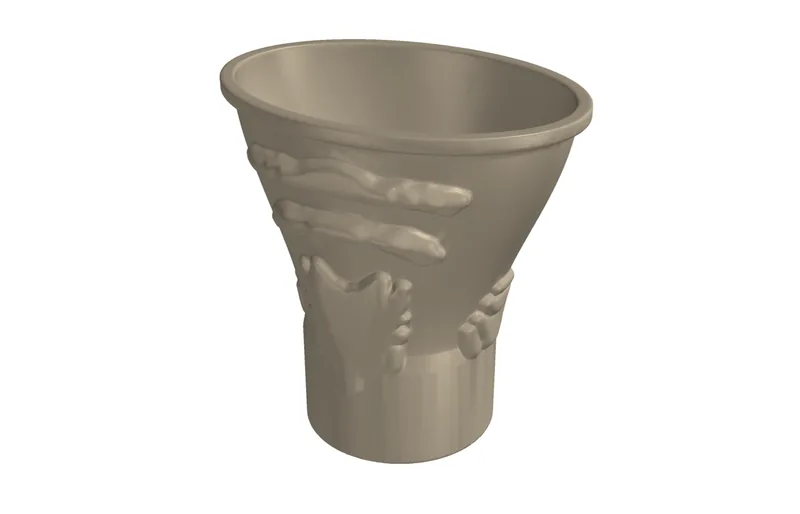
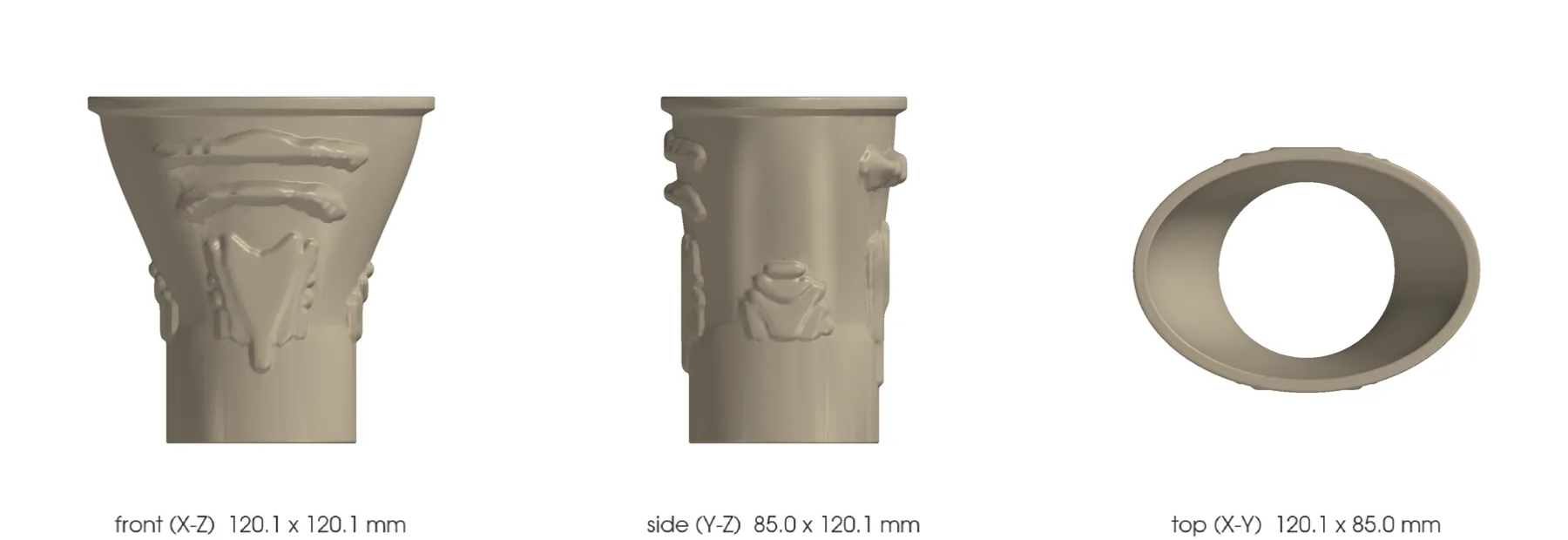
Independent round-to-oval concept with a ventilated double wall and eight integrated attachments to screen LPBF manufacture in IN625. FVD publishes only a 120 x 85 mm outlet envelope for its FVD11199300 stainless tip; PorscheFanatics separately documents an IN625 precedent on 993 Turbo exhausts.
The design
- Vehicle
- Porsche 993, 1994–1998
- Variants
- 993 C2, 993 C4, 993 RS narrow body
- Porsche part numbers
- Not recorded
- Category
- Exhaust tip
- Geometry basis
- Mixed
- Preferred process
- Not chosen yet
- Other candidate processes
- Laser powder-bed fusion (metal printing), Direct metal laser sintering (metal printing), sheet_metal
- Material
- EOS NickelAlloy IN625 / UNS N06625 for screening; FVD product declared stainless
- Material standard
- ASTM F3055, AMS 7000 or AMS 7001 to be contracted if the LPBF route is selected
Known limits
- Only the 120 x 85 mm outlet comes from FVD; length, inlet, double walls and attachments are hypothetical.
- The STEP volume gives 406.38 g in IN625; no comparable commercial mass is published.
- The Borda-Carnot loss screening is a sudden-expansion bound, not a prediction for the gradual diffuser.
- The 44.12 Hz strip mode is not a shell mode and cannot be compared with an absent vehicle spectrum.
- Temperatures, flow rates, pressures, volumetric efficiency and support conditions are synthetic.
- The calculation ignores pulses, upstream bends, joints, convection, CHT, ovalization, roughness, oxidation and thermal fatigue.
- The steady RANS CFD reaches its residual thresholds but the pressure loss still varies by 11.17% between the two finest meshes and the extended checks keep low-determinant cells.
- The full-part slicing and the EOS M 290 scene contain no supplier supports, no laser paths, and no correlated thermomechanical or recoater simulation.
- The SimReady profile passes only for an isolated prop; the physical properties invented by the agents were removed and no exhaust-valance assembly is available.
- PhysicsNeMo has only run a CUDA smoke test; no surrogate model is trained before the physical cases converge and are correlated.
- The STEP proves only a computable BREP within the envelope and must not be manufactured for fitting.
Post-processing it would need
- Complete powder removal through both ends of the double wall
- Stress relief qualified for the machine and parameters
- Build plate cut-off with ovality control
- Machining of the slip fit and clamping seat after adding machining stock
- Deburring and polishing of the gas path
- Passivation or surface finish to be defined after testing
What a supplier would have to provide
- Traceable powder, machine, parameters, orientation, lot and recycling
- Demonstrated capability on 0.8 mm double walls and a 2.7 mm open air gap
- Support strategy and distortion simulation before launch
- Dimensional inspection of the connection, oval, angle and clearances
- CT or radiography of the double wall and dye penetrant inspection after finishing
- Leak, vibration, thermal cycling and rear valance temperature tests before vehicle use
Sources
- FVD - 993 narrow-body oval stainless tips · read
FVD declares 120 mm at the widest, 85 mm at the tallest, stainless construction and C2/C4/RS applications. No inlet diameter, length, angle, thickness or datum.
- PorscheFanatics - register of declared materials · read
Documents 993 Turbo exhaust offerings declared in IN625; material precedent only, with no geometry and no fitment transfer.
- EOS NickelAlloy IN625 material data sheet · read
M 290 40 µm screening values, dependent on orientation and post-processing.
- Special Metals - INCONEL alloy 625 · read
Reference wrought thermal properties, never an LPBF allowables card.