Engine · 993-ENG-THREE-RUNNER-INTAKE-ALSI10MG-F0-0001
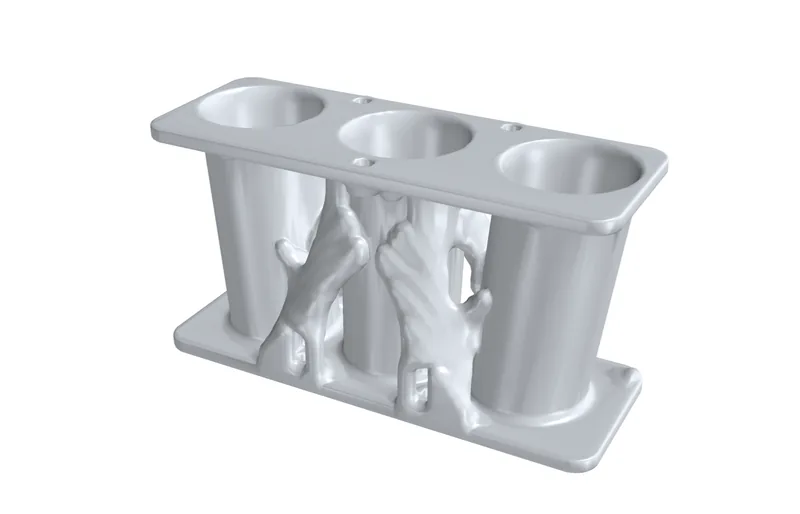
993 three-runner intake manifold, AlSi10Mg F0 concept
ConceptFunctional part
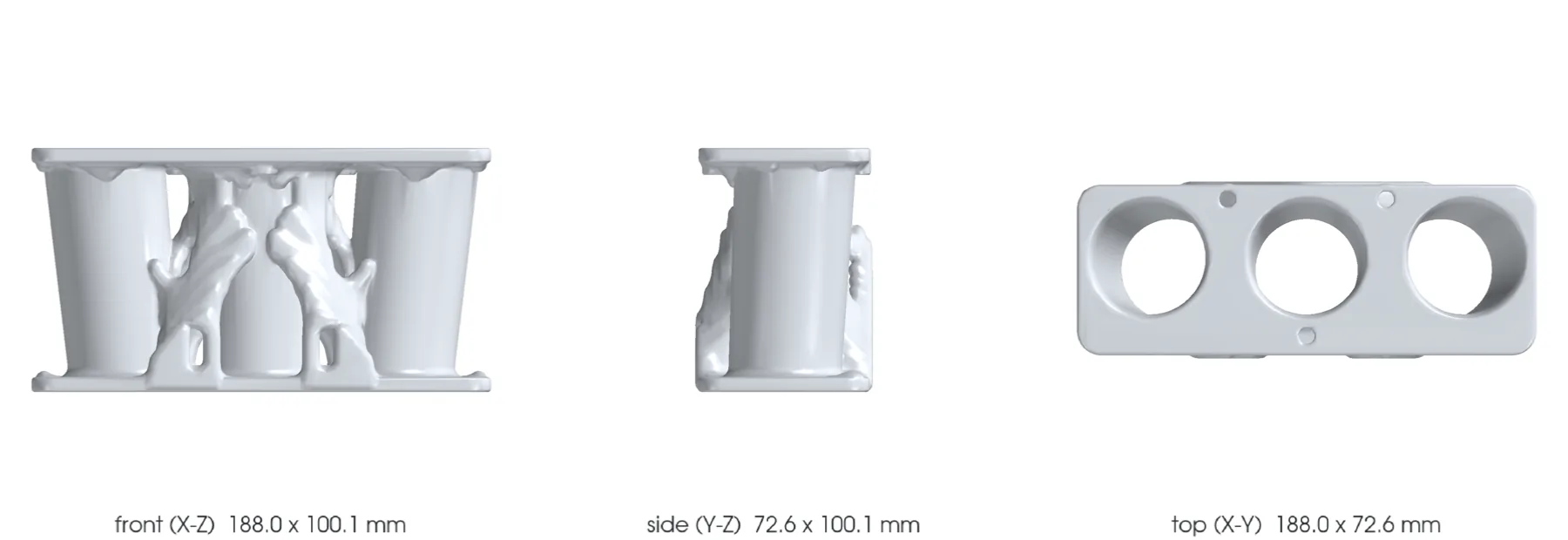
Independent concept of a manifold with three offset conical runners and two common flanges to screen AlSi10Mg LPBF. PorscheFanatics and Patrick Motorsports cross-check the PMO FUE PMO 9150 kit, stated as 46 x 42 x 100 mm, three bolts, two parts and a raw aluminum finish; no interface geometry is published.
The design
- Vehicle
- Porsche 993, 1994–1998
- Variants
- 993 3.6L conversion, 993 3.8L conversion, 964 shared engine conversion
- Porsche part numbers
- Not recorded
- Category
- Three runner intake manifold
- Geometry basis
- Mixed
- Preferred process
- Not chosen yet
- Other candidate processes
- Laser powder-bed fusion (metal printing), Direct metal laser sintering (metal printing), CNC machining, casting
- Material
- generic AlSi10Mg for screening; alloy and temper of the PMO product unknown
- Material standard
- ASTM F3318 and a program-specific engine specification to be contracted if LPBF is retained
Known limits
- The 46 x 42 x 100 mm string is not defined by a drawing; its interpretation as diameters and height remains hypothetical.
- The F0 spacings, offsets, flanges, thicknesses and absence of holes do not reproduce PMO or Porsche.
- The 461.03 g per bank and 922.07 g per pair cannot be compared with any published commercial mass.
- The flow at 6,800 rpm, the volumetric efficiency of 0.95 and the loss coefficient of 0.05 are synthetic.
- The 1D calculation ignores pulsations, interactions, roughness, plenum, injection, cylinder head conduction, fatigue and backfire.
- The STEP proves only a computable BREP and must not be manufactured for an engine.
Post-processing it would need
- Complete powder removal through the three open runners
- Stress relief and heat treatment qualified on representative coupons
- Build plate cut-off with flange flatness check
- Machining of both flanges, ports and holes after adding measured machining allowances
- Deburring, polishing or abrasive finishing of the gas path with verified roughness
- Particulate cleaning and leak test before any flow test
What a supplier would have to provide
- Traceable powder, machine, parameters, orientation, lot and recycling
- Capability on 2 mm walls, inclined runners and 6 mm flanges
- Support, recoater and distortion simulation before build
- CT of the runners and metrology of ports, flanges and future fastenings
- Porosity, roughness, flatness, leak-tightness and cleanliness contracted
- Flow, pressure, vibration, thermal cycling and engine dyno tests before vehicle
Sources
- PorscheFanatics - PMO 46 mm manifold for 964/993 engine · read
Cross-checks the 46 x 42 x 100 mm designation, three bolts, raw aluminum and the 964/993 engine fitment.
- Patrick Motorsports - PMO FUE PMO 9150 · read
States the set of two manifolds, 46 x 42 x 100 mm, three bolts, raw aluminum finish and 964/993 3.6-3.8 L Motronic conversions, without drawing or alloy.
- EOS Aluminium AlSi10Mg material page · read
LPBF family and process reference, not proof of the PMO alloy nor an engine allowables map.