Engine · 993-ENG-PISTON-CP1-GALLERY-F0-0001
M64/60 piston with cooling gallery, CP1 F0 concept
ConceptNot authorised until engineering review
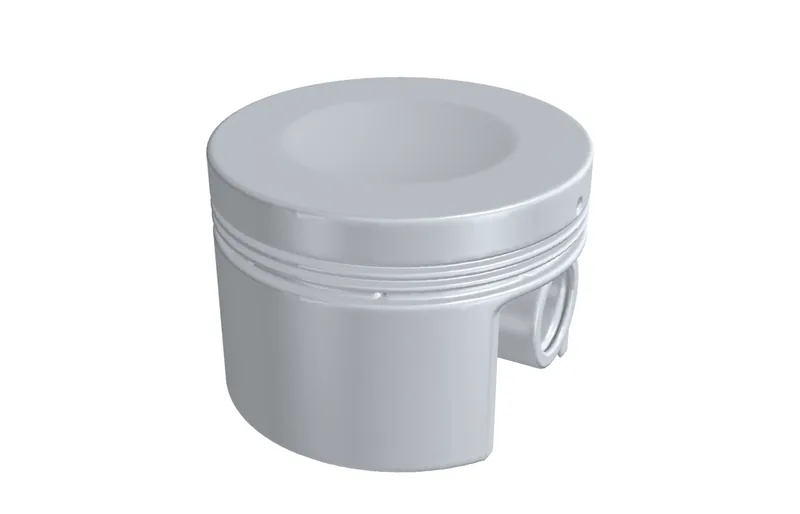
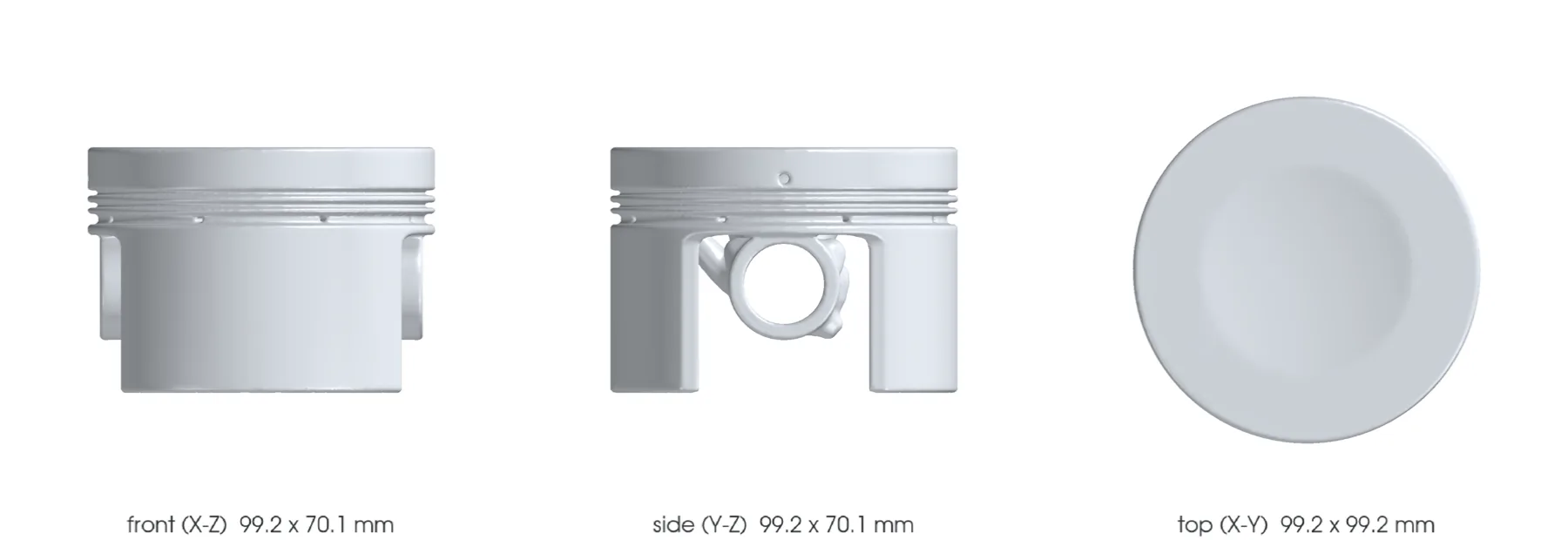
Independent concept of an Aheadd CP1 LPBF piston with a toroidal gallery under the crown and two temporary depowdering ports. Only the M64/60 bore/stroke/engine speed and the Porsche methodological precedent are published; the entire piston geometry remains an F0 hypothesis.
The design
- Vehicle
- Porsche 993, 1995–1998
- Variants
- 993 Turbo, M64 60 research
- Porsche part numbers
- Not recorded
- Category
- Piston with cooling gallery
- Geometry basis
- Mixed
- Preferred process
- Laser powder-bed fusion (metal printing)
- Other candidate processes
- Direct metal laser sintering (metal printing), CNC machining, casting
- Material
- Constellium Aheadd CP1, Velo3D Sapphire 50 µm route for screening only
- Material standard
- AMS7074 for the powder and a program-specific piston/machine specification to be contracted
Known limits
- The 100 mm engine bore, the 76.4 mm stroke and the limiter are documentary; no 993 piston dimension is published here.
- The F0 99 mm diameter, 70 mm height, cavity, pin, ring grooves, bowl and gallery are entirely synthetic.
- The Porsche precedent, 10% lighter, closed gallery and 200 h, concerns a modern 911 GT2 RS piston, not this F0 nor a 993.
- The CAD mass of 681.32 g depends on the synthetic shape and is not compared with any measured 993 piston mass.
- The 12 MPa cylinder pressure, the pin/ring masses, the 2 l/min of oil, 5 kW and +200 K are unmeasured regression cases.
- The room-temperature margin of 1.07 from a circular plate and a minimum CP1 limit is not a hot design margin.
- The 1D models ignore transient combustion, skirt/cylinder contact, rings, lubrication, oil acceleration and multiaxial fatigue.
- The slicing into 2,390 layers, the roll_y_45 orientation and the 8.365 cm3 of supports are a geometric screen; no Flow project, distortion field or recoater check is available.
- The SimReady pass validates an isolated prop, not the piston-cylinder-rings-pin-connecting rod assembly nor the engine function.
- The PicoGK F0 sweep inspired by the Porsche and IAV architectures generated six variants and up to 1.60% gross weight saving, but none passes the provisional room-temperature plate margin of 1.50 and all six STLs keep non-manifold edges.
- The sound BREP master went through six CalculiX runs on three meshes: the hot p95 reaches 323.46 MPa and exceeds the room-temperature CP1 reference of 297 MPa in the synthetic case, despite a mesh sensitivity below 1% on that p95.
- PicoGK is a geometry kernel; without FEA of the manifold variants, CHT/VOF, hot CP1 allowables and measured interfaces, no variant constitutes an optimized or selected piston.
- The STEP proves only a readable BREP with a gallery opened by two ports; it is authorized neither for manufacturing, nor fitting, nor engine use.
Post-processing it would need
- Controlled removal of all powder through two opposed temporary ports
- 400 °C treatment for 4 h per the published route, to be requalified on the part
- HIP to be decided after analysis of defects, fatigue and the gallery
- Port closure by a qualified process, then proof test and CT of the gallery
- Machining of the diameter, skirt, ring grooves, pin bores and datum faces
- Finishing, anti-friction coating, pin/ring matching and set balancing
What a supplier would have to provide
- Traceable CP1 powder, machine, parameters, orientation, lot and recycling
- Oriented coupons with tensile, fatigue, creep, conductivity and expansion from room temperature to the qualified temperature
- Distortion simulation and witnesses for crown, gallery, bosses and ring grooves
- CT before and after machining/port closure, gallery porosity and thickness contracted
- Metrology of skirt profile, ovality, taper, compression height, ring grooves, pin and end-to-end mass
- Hydraulic proof test, thermomechanical cycles, full-scale fatigue and 200 h engine testing before vehicle
Sources
- PorscheFanatics - additive piston precedent and 993 pistons · read
Establishes the candidate and the closed-gallery precedent only; no 993 CP1 geometry or grade.
- Porsche Newsroom - laser-fused pistons · read
For the modern GT2 RS project, Porsche states a load-adapted structure, 10% less mass, a closed gallery under the crown and 200 h of engine testing. Method reference only, with no transfer to the 993.
- elferclassic - German technical data of the 993 Turbo · read
Publishes six cylinders, 100 mm bore, 76.4 mm stroke and a 6,720 +/- 20 rpm limiter. These engine values do not define the piston.
- Velo3D - Aheadd CP1 Material & Process Capability · read
Publishes, for Sapphire/50 µm, machined vertical specimens and 400 °C/4 h: density 2.67 g/cm3, minimum Rp0.2 297 MPa and minimum Rm 331 MPa. These are not hot/fatigue piston allowables.
- Constellium - Aheadd CP1 product fact sheet · read
Publishes 187 W/m.K at room temperature and qualitative stability over several thousand hours at 250-300 °C, without a full hot property map.
- IAV / GVSETS 2018 - additive diesel piston · read
Architecture precedent: triangulated lattice and separate cooling circuits on a heavy-duty diesel piston of about 130 mm. No dimension or property is transferred to the M64/60 CP1.