Engine · 993-ENG-OIL-FILTER-CONSOLE-ALSI10MG-F0-0001
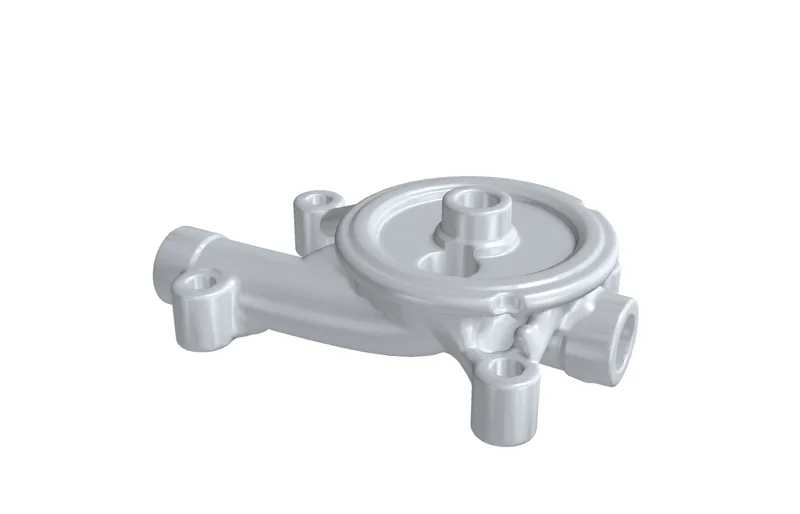
Engine oil filter console with integrated galleries, AlSi10Mg concept F0
ConceptNot authorised until engineering review
Independent concept of a 993 console combining filter seat, two non-collinear galleries and two ports in a single body. The sources establish the part numbers, a commercial mass and the MAHLE OC 229 filter interface, but no OEM geometry; all F0 interfaces remain synthetic.
The design
- Vehicle
- Porsche 993, 1994–1998
- Variants
- 993 M64 fitment to confirm
- Porsche part numbers
- 99310705700, 99310705701
- Category
- Engine oil filter console
- Geometry basis
- Mixed
- Preferred process
- Not chosen yet
- Other candidate processes
- Laser powder-bed fusion (metal printing), Direct metal laser sintering (metal printing), CNC machining, casting
- Material
- EOS Aluminium AlSi10Mg T6 for comparison; analogous commercial architecture in 6061-T6 billet
- Material standard
- DIN EN 1706 EN AC-43000 and ASTM F3318 for the candidate; program-specific oil, sealing and cleanliness specification to be contracted
Known limits
- PorscheFanatics identifies the part and the filter but provides neither geometry nor material.
- The 0.78 kg mass is a commercial claim with no protocol and no weighing boundary.
- The 76 x 101 mm, M20x1.5 and 72/62 mm dimensions concern the OC 229 filter, not the console.
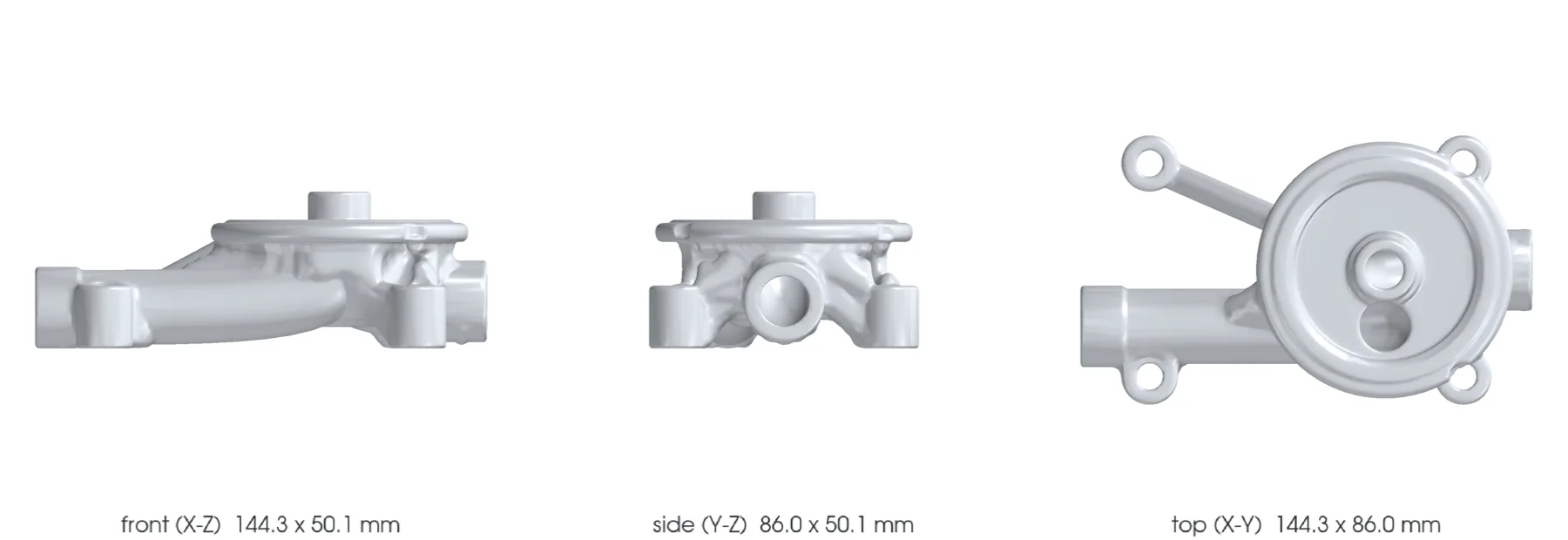
- The 144 x 90 x 50 mm body, the four mounting points, two ports and two galleries are entirely synthetic.
- The 6.5 bar pressure is an unverified OCR occurrence; flow, viscosities, local losses and roughness are scenarios.
- The filter, its bypass valve and the engine circuit are absent from the hydraulic calculation.
- The cold screen and the constrained thermal screen fail.
- No internal cleanliness, sealing, fatigue, corrosion, CHT-CFD or engine integration is demonstrated.
- The STEP proves only a re-readable BREP; no manufacture, oil circulation or start-up is authorized.
Post-processing it would need
- Orientation and supports ensuring all galleries are open, to be qualified
- Stress relief then T6 with distortion and porosity monitored
- HIP to be decided on fatigue, sealing and tomography results
- Machining of the case face, ports, drillings, bosses, filter seat and M20x1.5 thread
- Validated internal deburring, powder removal, flushing and particle extraction
- Surface treatment compatible with oil, seals, threads and temperature
- Final packaging to engine cleanliness standards
What a supplier would have to provide
- Traceable machine, parameters, orientation, supports, powder and batch
- Oriented coupons with tensile, fatigue, oil corrosion and hot pressure tests
- Gallery witnesses for roughness, powder removal and residual cleanliness
- Full CT, FPI and metallography with zoned defect criteria
- Metrology of the datums, ports, case face, thread, filter seat and drillings
- Proof of pressure, burst, leakage, flow, thermal cycling, vibration and engine endurance
Sources
- PorscheFanatics - 993 engine oil filter console and filter · read
Identifies consoles 993 107 057 00/01 and the engine filters including 993 107 203 03/MAHLE OC 229; no geometry and no material.
- OEMVWShop - Porsche console 993 107 057 01 · read
Declares 0.78 kg with no weighing boundary and no protocol; mass comparison only.
- MHTeile - MAHLE OC 229 filter for Porsche 993 · read
Publishes a 76 x 101 mm filter, M20x1.5; distributor data add 72/62 mm, 20 Nm and 333 g. These dimensions concern the filter, not the console.
- Islandworks - integrated thermostat/filter console, 6061-T6 · read
Functional precedent in 6061-T6 billet using a 993 filter; it is not a 993 replacement part and no geometry is reused.
- PorscheFanatics - 993 manual data · read
Unverified OCR occurrence: about 6.5 bar at 5,000 rpm and 90 °C for the Carrera. Used as a regression reference, never as a released load case.
- EOS Aluminium AlSi10Mg material data sheet · read
T6 route and candidate material; numerical values of the calculation kept as generic comparisons.