Engine · 993-ENG-INTERCOOLER-BRACKET-TI-F0-0001
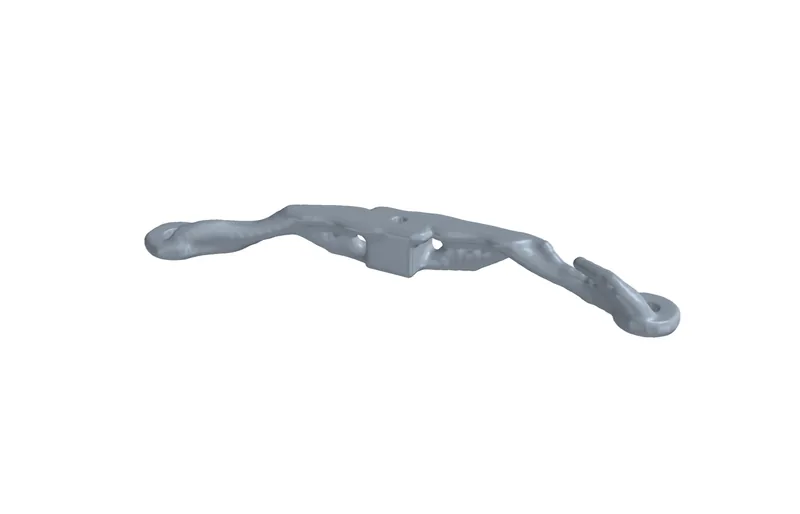
993 Turbo/GT2 intercooler bracket, titanium F0 concept
ConceptFunctional part
Independent open two-rail bracket concept to screen the value of an LPBF remanufacture in Ti-6Al-4V. PorscheFanatics and the PET establish the circuit part numbers; FVD publishes the envelope and mass of a reinforced aftermarket bracket, without usable interface geometry.
The design
- Vehicle
- Porsche 993, 1995–1998
- Variants
- 993 Turbo, 993 GT2
- Porsche part numbers
- 99311011050, 99311011052
- Category
- Charge air support
- Geometry basis
- Mixed
- Preferred process
- CNC machining
- Other candidate processes
- Laser powder-bed fusion (metal printing), sheet_metal
- Material
- Ti-6Al-4V Grade 5 for screening; OEM material and FVD product unknown
- Material standard
- ASTM F2924 or equivalent supplier specification to be contracted
Known limits
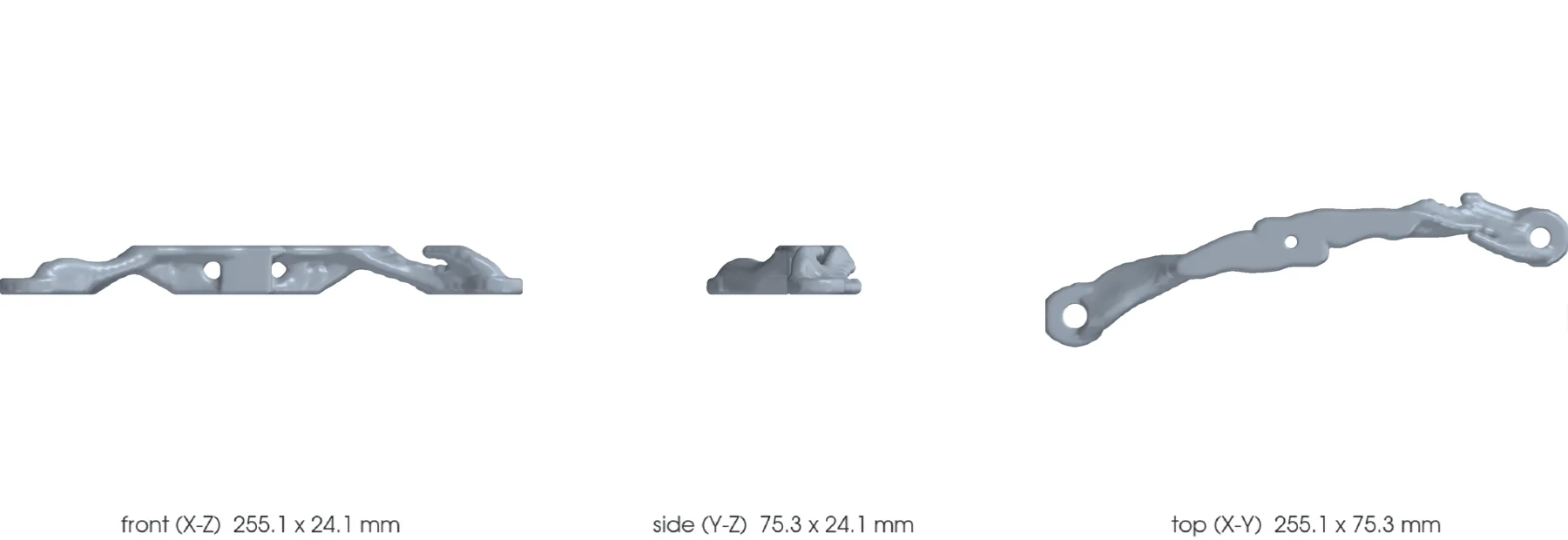
- Only the 255 x 80 x 23 mm envelope comes from the commercial record; the rails, holes and central boss are F0 assumptions.
- The published 0.2 kg mass concerns the FVD product whose exact material and topology are unknown; it does not validate the concept.
- The 400 N central case, the 220 mm span and +120 K are synthetic; no 993 load has been measured.
- The beam calculation ignores curvature, stress concentrations, contact, preload, vibration, fatigue, LPBF defects and thermal stresses.
- The 828 MPa comparison limit comes from a wrought TIMET reference and is not an LPBF allowable.
- The CalculiX C3D10 screen converges to within 10% on p95 and deflection, but keeps synthetic supports, load and elastic card; the local maximum still rises with refinement.
- The derived USD passes the minimum structural check only; it carries no qualified SimReady physical attribution.
- The STEP proves only a computable BREP within the envelope; it must be neither manufactured for fitting nor installed.
Post-processing it would need
- Support removal keeping access to the two open recesses
- Heat treatment qualified for the machine, parameters and orientation
- HIP to be decided after fatigue analysis and defect population
- Machining of the end bores and central interface after clearances are defined
- Deburring, radiusing and finishing of load paths
- Passivation and galvanic isolation after dimensional inspection
What a supplier would have to provide
- Traceable powder, machine, parameters, orientation, lot and powder recycling
- Witness coupons in critical orientations with representative tensile and fatigue
- Dimensional inspection of datums, center distances, bores and envelope
- CT of nodes and bosses, then dye penetrant inspection after machining
- Contracted roughness, porosity, alpha case and residual stresses
- Instrumented static, vibration and thermal tests before any fitting
Titanium route
- Alloy
- Ti-6Al-4V Grade 5 candidate only
- Heat treatment
- Indicative EOS cycle to be confirmed for the selected machine and parameters; no recipe is frozen
- Hot isostatic pressing
- To be determined
- CT of bosses and rail junctions
- Dimensional inspection of machined interfaces
- Dye penetrant inspection after machining
- Roughness and porosity
- Tensile and fatigue coupons representative of the orientation
Sources
- PorscheFanatics - PET transcription of the 993 Turbo groups · read
The catalogue locates the forced induction circuit and its brackets. It provides identity and context, but no dimension, tolerance or CAD surface.
- FVD - reinforced intercooler bracket FVD11011050 · read
FVD declares 255 x 80 x 23 mm, 0.2 kg and a 993 Turbo/GT2 application. The envelope is kept; the rails, holes and central boss of the F0 are independent.
- EOS Titanium Ti64 Grade 5 material data sheet · read
LPBF/DMLS process reference: anisotropy, machine parameters and heat treatment must be qualified.
- TIMETAL 6-4 physical properties · read
Density, modulus, expansion and minimum yield of wrought sheet are used for screening only; they are not LPBF allowables.