Engine · 993-ENG-EXHAUST-MANIFOLD-IN625-F0-0001
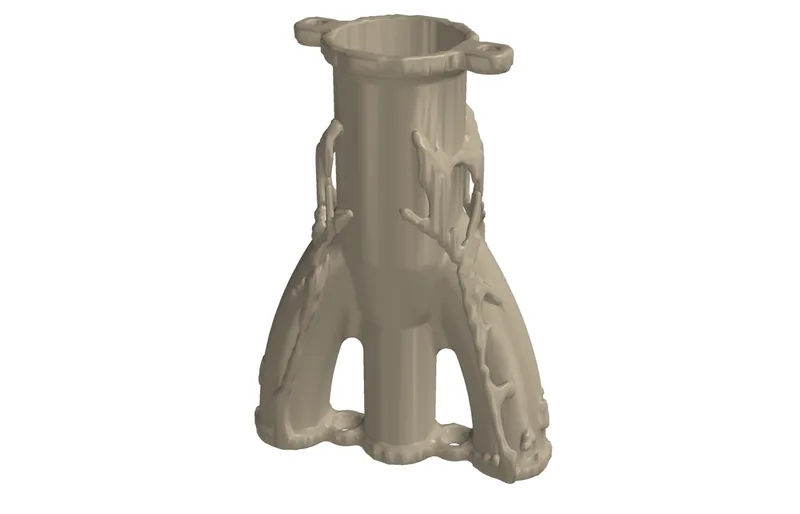
993 Turbo three-into-one exhaust manifold, IN625 F0 concept
ConceptNot authorised until engineering review
Independent concept of an IN625 three-into-one flow core to screen LPBF manufacturing without internal welds in the manifold. Kline and PorscheFanatics publish an IN625 offer at 2.9 kg per side with heat exchanger; the PET identifies the left and right parts. No public geometry is used.
The design
- Vehicle
- Porsche 993, 1995–1998
- Variants
- 993 Turbo, M64 60 research
- Porsche part numbers
- Not recorded
- Category
- Exhaust manifold flow core
- Geometry basis
- Mixed
- Preferred process
- Not chosen yet
- Other candidate processes
- Laser powder-bed fusion (metal printing), Direct metal laser sintering (metal printing), sheet_metal
- Material
- EOS NickelAlloy IN625 / UNS N06625 for screening
- Material standard
- ASTM F3055, AMS 7000 or AMS 7001 and a program-specific exhaust specification to be contracted
Known limits
- Only the 993 Turbo identity, the IN625 material and the 2.9 kg mass with heat exchanger are published.
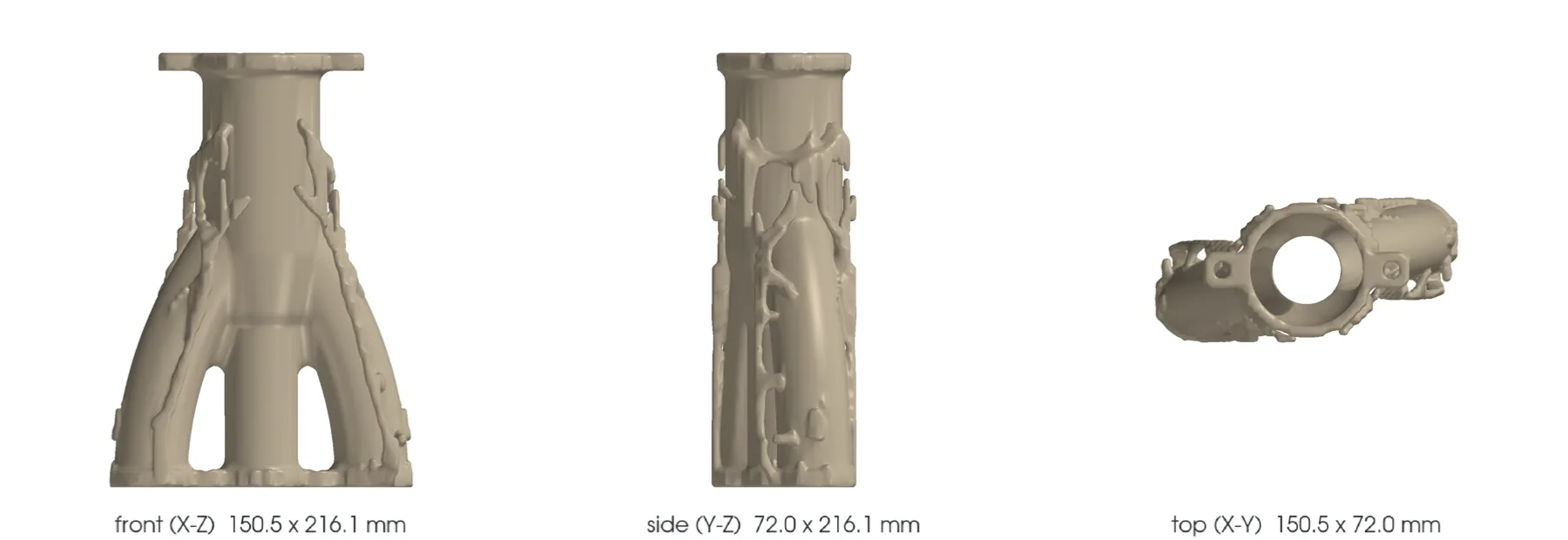
- The diameters, thickness, spacings, paths, length and three-into-one junction are entirely synthetic.
- The STEP omits flanges, turbine, heating heat exchanger, brackets, gaskets and installed environment.
- The computed core mass of 509.97 g cannot be compared as an equivalent to the 2.9 kg commercial assembly.
- The 1D flow assumes 3.6 L, 5,750 rpm, volumetric efficiency 0.95, gas at 900 K and equal sharing between cylinders.
- Loss, stresses, expansion, radiation and acoustics are analytical screens, not CFD/FEA/CHT results.
- The STEP proves only a single BREP with a connected internal volume and is not authorized for manufacturing or engine use.
Post-processing it would need
- Complete powder removal through three open inlets and one open outlet
- Stress relief, heat treatment and possible HIP qualified on representative witness coupons
- Build plate cut-off and support removal with no internal support
- Machining of flanges and interfaces after adding measured machining allowances
- Internal finishing with controlled roughness and residual wall thickness
- Particulate cleaning, dye penetrant, CT and leak proof test before thermal testing
What a supplier would have to provide
- Traceable powder, machine, parameters, orientation, lot and recycling
- Demonstrated capability on a 1.2 mm hot wall and an unsupported internal manifold
- Support, recoater and distortion simulation before build
- Coupons in critical orientations with hot, fatigue, creep and oxidation properties
- CT of the three-into-one junction and metrology of walls, ports, flanges and future fastenings
- Comparison with the bent/welded manifold on cost, mass, loss, service life, repairability and inspection
Sources
- Kline Innovation - Porsche 993 Turbo exhaust · read
States IN625 and 2.9 kg per manifold with heat exchanger; no dimension or manufacturing method.
- PorscheFanatics - IN625 manifolds with heat exchanger for 993 Turbo · read
Cross-checks the Kline offer and the Fabspeed 3-into-1 precedent, without geometry or topology transfer between products.
- Porsche PET 993 - Turbo exhaust and heat exchangers 202-10 · read
Identifies the left 993 211 039 55 and right 993 211 040 55 heat exchangers and the interfaces to measure, without dimensions.
- EOS NickelAlloy IN625 material data sheet · read
LPBF M 290 screening reference, dependent on orientation and post-processing.
- Special Metals - INCONEL alloy 625 · read
Reference wrought thermal properties, not equivalent to an LPBF allowables map.