3D assembly · flat-12 · four valves · twin turbo · vehicle packaging
Parametric assembly · F15 vehicle packaging trial · functional qualification open
The flat-12 takes shape.
Real passages, shaped accessories.
The mechanical revision replaces the earlier accessory blocks with shaped native parts: intercoolers, charge-air routes, a cam-drive enclosure, electrical-device envelopes, oil-pump bodies and branching supports. Separate parts and placements remain inspectable. This is cold design geometry, not a running engine. A separate whole-vehicle trial now packages a schematic engine reservation in an extended 911; it does not place this assembly in a car.
Evidence reviewed through ; mechanical assembly unchanged since 12 October 2026
01 / The assembly
154 definitions, 1,399 placements
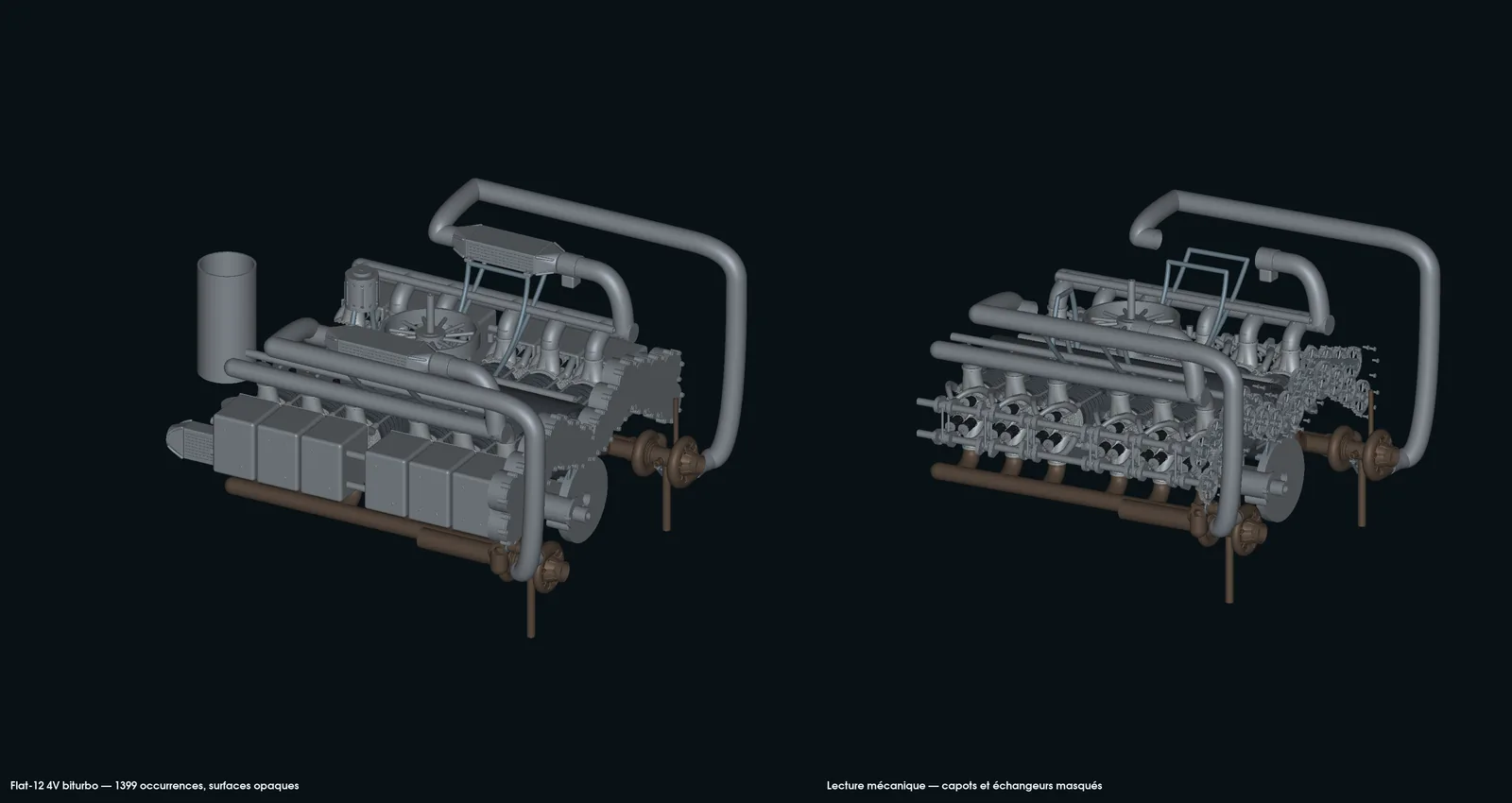
The earlier four-valve heads, seats, guides and gear trains are preserved. The new work changes the accessory geometry and its placement. The two bionic turbos retain their original 39 prototypes and 78 placements. Engine interfaces, clearances, hot behaviour, loads and assembly hardware remain to be qualified.
02 / The new parts
Passages, housings and branching supports
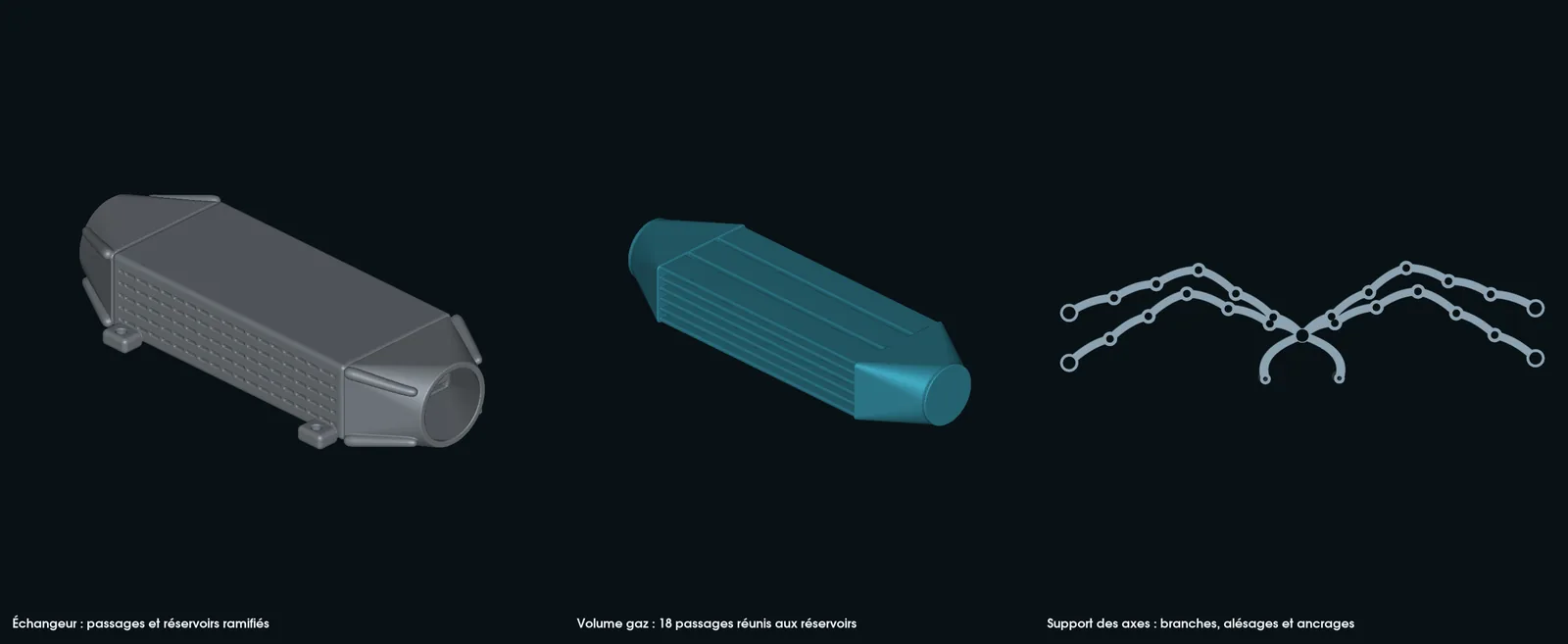
- Intercooler bodies with through gas and cross-air passages, profiled tanks and curved external ribs.
- Charge-air routes from each turbo through its intercooler and throttle to the head manifolds; the former direct routes are removed.
- A fitted cam-drive housing, backplate, branching shaft support, removable cover and hex-head fastener representations.
- A ventilated alternator and pulley, a shaped starter and solenoid, a finned control enclosure and through-bore throttles.
- Seven lobed oil-pump bodies with covers and fitting reservations, plus hollow rounded head covers and accessory supports.
03 / Cam drive carried forward
Involute gears with branching webs
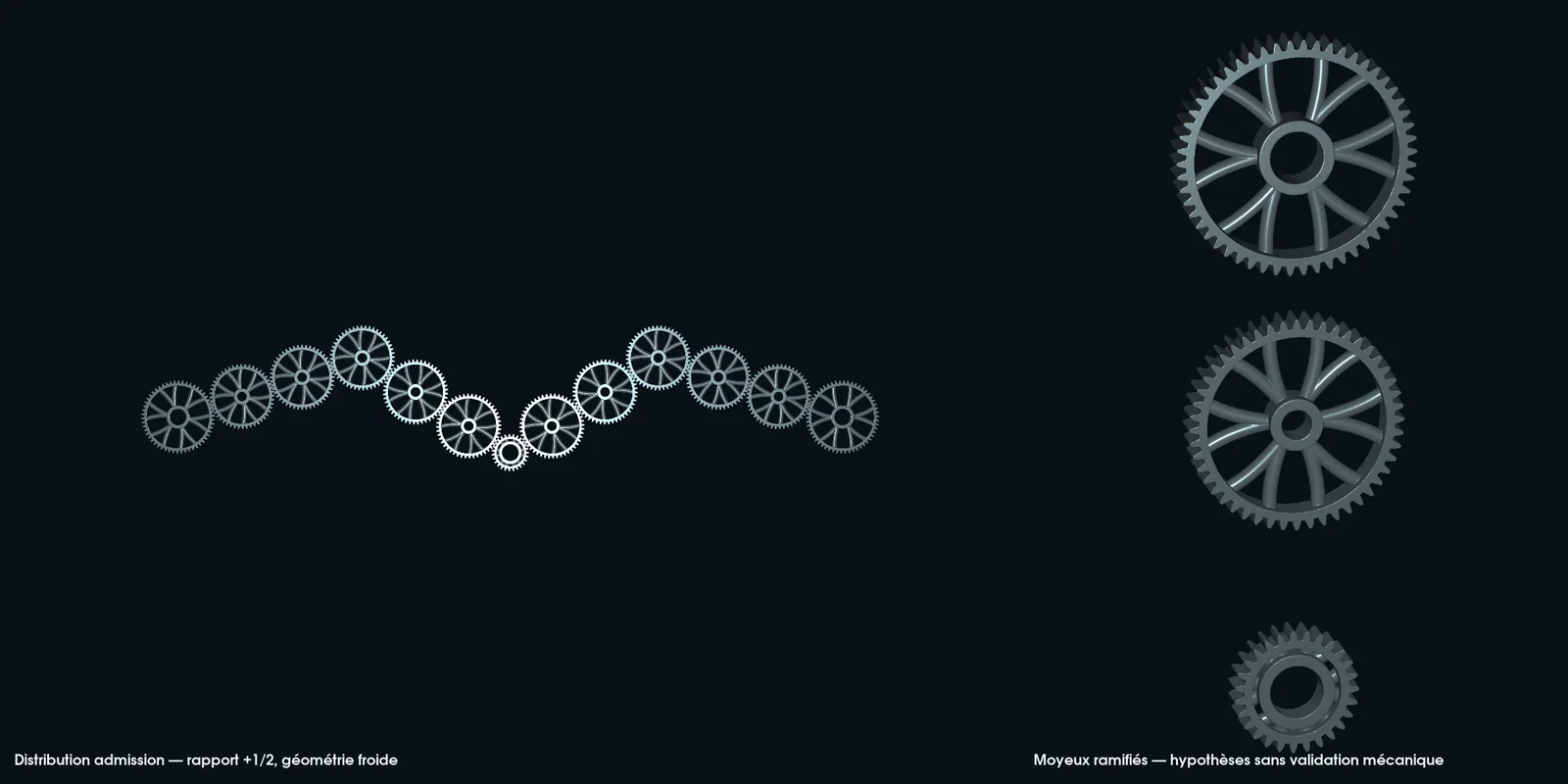
Two 27-tooth crank gears, twenty 48-tooth idlers and four 54-tooth cam wheels form four trains. Five idlers per cam reach the target axes with the required positive direction; six meshes give exactly half a cam revolution for each crank revolution.
The chosen 1.5 mm module, 20° pressure angle, 12 mm width and 0.4 mm nominal circular backlash are study inputs. Two branching-web sizes were compared with solid witnesses by volume. A smaller volume does not establish better strength, fatigue life or torsional behaviour.
The next evidence
- Identify the exact engine variant and measure its functional interfaces.
- Define shafts, bearings, retainers, torque connections and drive supports.
- Check full-cycle interference, tooth loads, lubrication, torsional dynamics and fatigue.
- Select materials, finishing and manufacturing routes under professional review.
Separate / 911 vehicle integration
F15: 47 packaging volumes in one vehicle model
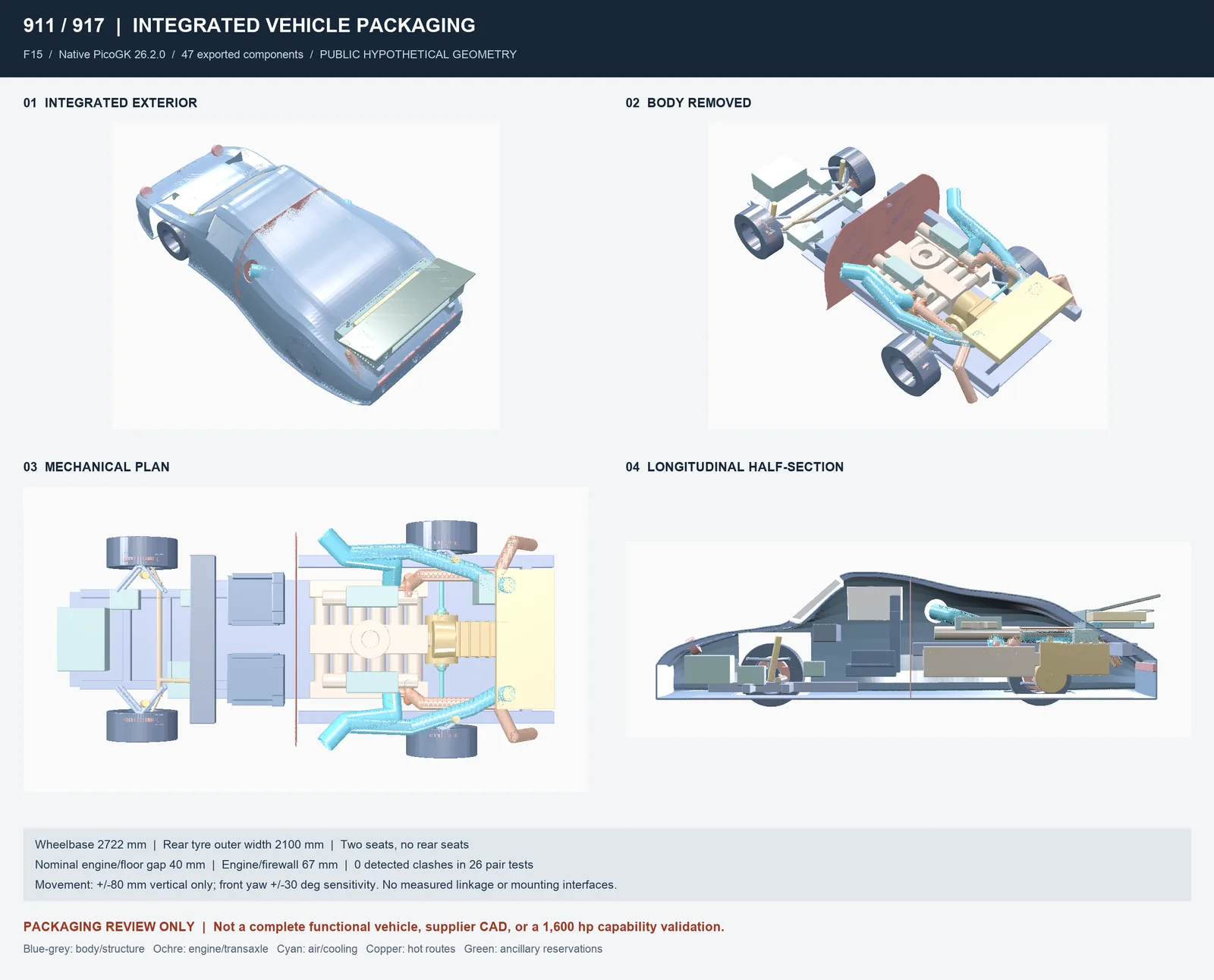
F15 brings the earlier vehicle hypotheses into one native PicoGK model of 47 separately exported geometries: body shell, floor, a straight firewall, structure corridors, two front seats and no rear seats, the engine reservation and proxy, transaxle, two turbos, halfshafts, wheels, brake, suspension and steering reservations, quarter-window intakes, exhausts, a fixed 930-style tail with a heat-exchanger reservation, and seven equipment boxes. The wheelbase is 2,722 mm, 450 mm longer than the 993's, with the 1,150 × 1,200 × 800 mm engine reservation ahead of the rear axle.
The floor is lowered to leave a nominal 40 mm under the engine reservation, against 10 mm in the earlier F14 driveline trial. The firewall moves forward and leaves 67 mm to the engine after its wall thickness. For the checks, the engine is expanded by 30 mm towards floor and body and by 60 mm towards the firewall. On 12 October 2026 the 5 mm native run found no intersection in 26 named pair tests. Three earlier local iterations are retained, including rejected floor/exhaust and engine-cover/duct intersections. The narrower 880 mm front floor, the exhausts routed outside the rear crossmember and the raised engine-bay roof are proposals, not recovered 930 dimensions.
F14 cleared its shaft/frame intersections with an assumed 1,840 mm rear track and ±80 mm vertical-only hub motion, and remains unselected. F15 carries that track forward as a trial and makes its width consequence visible rather than resolving it: the tyres still need 2,100 mm outer width and the body stations reach 2,200 mm nominal width. Neither width is selected, and neither establishes traction at the intended 1,600 PS. Wheel motion is prescribed as ±80 mm vertical travel and ±30° front yaw; the displayed links do not determine it, and toe, camber, caster and bump steer are unknown.
An optional private overlay can replace the proxy in the views with the owner's uncalibrated engine scan, aligned to its cylinder rows. On 14 October 2026 the alignment receipt gained stricter checks before the scan is placed: producer flags, input digests, a rigid transform without scale, shear or reflection, an unchanged scan, and aligned bounds within 1 mm of the receipt. The build, the rejection tests and the report checks pass; the private overlay was not rerun with these checks. No scan, derived mesh or scan render is published here.
The vehicle study uses its own hypotheses and does not establish that the mechanical flat-12 assembly above fits a 993 or any 911. Functional completion needs measured body and suspension datums, a calibrated engine scale and output interface with a complete-engine envelope, a supplier transaxle drawing and accepted torque duty cycle, real steering, brake, fuel and cooling equipment, masses and centres of gravity, and an approved load and validation plan.